Designing a Self-Service Codebase Knowledge Layer so Junior Engineers Stop Pinging You
Build searchable code context so juniors answer their own questions.
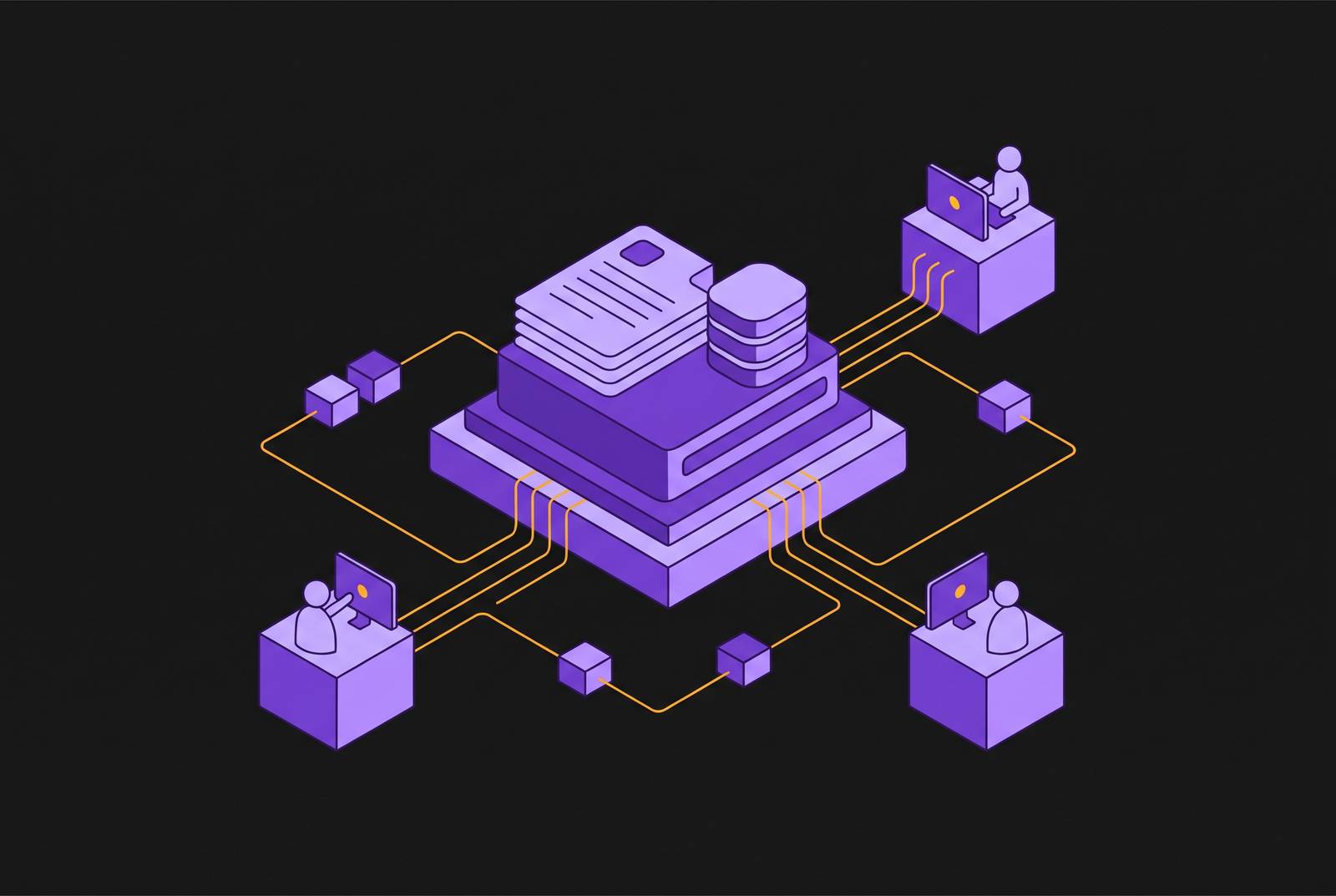
Engineering onboarding becomes faster when new hires can find how code connects, why it was designed that way, and grounded answers without asking a senior engineer. Building a self-service codebase knowledge layer means keeping that context so both developers and AI agents can search it and use it. The interrupt loop is an information architecture problem.
Why senior engineers become the default answer key for junior questions
A junior engineer joins, opens the repository, and finds no navigable entry point. They need to understand where auth middleware is wired up, but the directory structure does not explain the request path. Search returns matches without explaining how they connect. Asking a person is the next reasonable step. The senior engineer knows the answer because they hold context that the repository does not make accessible.
That exchange becomes expensive when it is the default route to understanding. Each ping requires the senior engineer to rebuild the question’s context, formulate an answer, and then recover the context of their own work. The cost compounds across otherwise routine questions. Meanwhile, the answer stays confined to a conversation.
A wiki may explain what a service does while leaving questions about why a pattern was chosen or what breaks when a dependency changes unanswered. Grep, GitHub search, and a flat wiki leave gaps on cross-file and cross-service questions. Junior engineers are using the only interface that connects structure with reasoning.
What a knowledge layer actually needs to do — the three jobs that replace a human answer
A self-service knowledge layer has three distinct jobs. Structural mapping explains what exists and how it connects, including service calls, function definitions, and imports. Decision archaeology explains why architectural choices were made and what constraints shaped them. Question answering uses those resources to give specific, natural-language answers based on the actual code. Each job replaces a different part of a senior engineer’s explanation.
These jobs depend on one another. Structural maps and decision records make the documentation better, but without a usable question interface, a senior engineer may still need to help. Question answering without those foundations produces shallow or hallucinated responses because it lacks the relationships and reasoning needed to answer well. The practical sequence is therefore to establish structure, recover decision history, and make both queryable.
Building the structural map — making the codebase navigable before anyone asks a question
A structural map needs deterministic relationships and readable explanations. A parser establishes edges such as imports, function calls, and inheritance, while semantic annotation explains what those relationships mean to someone unfamiliar with the codebase. The two layers serve different purposes. Parsing establishes topology rather than asking a language model to infer it, while annotation helps a new hire interpret that topology.
Understand-Anything, the open-source project from Lum1104, illustrates this parse-then-annotate approach. It combines Tree-sitter parsing with an LLM-driven multi-agent pipeline that adds semantic reasoning to the structural model. The output is a committed knowledge graph. After the first index, the graph updates incrementally on each commit, allowing the next engineer to use the map and avoid repeating the initial analysis. Committing it to the repository makes that analysis a shared investment.
For public or inner-source repositories that can use it, DeepWiki offers another route to a structural picture. It generates an architecture wiki with diagrams and grounded question answering from code, with no sign-up required. The resulting navigation is useful. Once the relationships are mapped, a query can find where auth middleware is applied across the service layer, saving someone from having to piece the connections together by hand.
Recovering decision history — linking code to the reasoning that shaped it
A structural map can locate the auth service and trace its dependencies, leaving questions about why an unusual design was chosen and which constraints made the standard approach unsuitable unanswered. Those questions require provenance. Without it, a junior engineer still needs someone who remembers the discussion, even after finding every file that bears on the question.
Architecture Decision Records, or ADRs, make that reasoning available to future readers. These short documents live in the repository and record the context, options considered, and decision made. Their usefulness depends on links to the code they explain. An isolated ADR folder leaves the reader with another search problem rather than an explanation attached to the implementation.
To make those links part of routine work, a PR introducing a non-obvious pattern should include its ADR. When a junior engineer asks why that pattern exists, the first answer should be the record. Currency is equally important for preserving trust. Kage stores decisions, bug fixes, and conventions as plain Markdown files in the repository, checks their code citations, and withholds context that no longer matches.
The same records can also support AI agents. Kilo Code uses AGENTS.md to keep architectural decisions across sessions in place of its deprecated Memory Bank feature. That gives agents access to reasoning that would otherwise disappear between interactions. Human-readable decision history therefore serves two consumers without requiring two separate accounts of the architecture.
How can new engineers find answers across an unfamiliar codebase?
A searchable knowledge layer must accept the question a new hire can formulate. Internal wikis often organize information around the team’s established view of the codebase. A newcomer approaches from an unfamiliar problem instead. If finding the answer requires knowing which domain or repository owns it, the interface preserves the original dependency on a senior engineer.
Cursor’s semantic index chunks and embeds a repository, while a separate Merkle tree supports efficient change detection and synchronization. A natural-language query about where auth middleware is wired up can return relevant files and a coherent call chain. File paths alone are not the destination. The answer needs enough connected context for the engineer to understand what those files do together.
A single-repository tool cannot provide the same reach as a platform that indexes all repositories and makes cross-repo context navigable. A self-hosted code intelligence platform can give everyone a way to search those repositories. Teams should choose based on how well queries work, which repositories they cover, and how the results connect, as well as whether search is available. The natural-language interface also gives non-engineering colleagues and support staff a way to understand behavior without reading code fluently.
How AI coding agents fit into the knowledge layer — and why context determines their usefulness
An AI coding agent working only from the open file faces a familiar limitation. It can solve the local problem without understanding the surrounding system, producing a change that looks correct in isolation but conflicts with the architecture. More generation does not supply missing context. The structural maps and decision records built for onboarding give agents access to the relationships and constraints that local editing leaves out.
The Model Context Protocol, or MCP, provides the integration layer between agents and external tools. A team can wrap architecture documents, runbooks, ADRs, and deployment configurations in one MCP server for compliant agents to query. Claude Code and Cursor are both MCP-aware. This replaces a custom integration for each tool with a shared interface to the internal knowledge base.
Access design still requires attention to the deployment model. MCP’s OAuth 2.1 authorization model for HTTP-based servers delegates authentication to a separate authorization server, keeping raw user passwords out of the LLM context window. Local stdio-based servers usually use environment-variable credentials, while many deployments still use static API keys. These authorization arrangements provide different guarantees.
MCP is under the governance of the Agentic AI Foundation, a directed fund under the Linux Foundation. That provides an institutional context for teams considering a long-term infrastructure dependency.
The risk that context-free AI assistance creates for junior engineers specifically
A junior engineer may accept code that works without knowing why it works or which surrounding changes could break it. Output can improve while architectural judgment remains underdeveloped. Without a structured knowledge layer, the team risks replacing questions to senior engineers with unexamined acceptance of generated code.
Garima Agarwal wrote about an engineering team where AI tools improved velocity metrics for six months while junior engineers shipped code they did not understand. They were checking diffs instead of making decisions and approving working code without understanding its dependencies. The team changed the structure of the work. It separated output tasks, where AI assistance was fully encouraged, from learning tasks, where building a mental model took precedence over shipping speed.
Under that structure, time to meaningful contribution dropped from seven months to four. The team defined that milestone as the first incident a junior engineer could work through independently. That result came from changing how tasks were set up, and did not measure what happened when a knowledge layer was deployed. Learning should remain an explicit goal. A record of architectural reasoning that juniors can query helps them work toward that goal by checking why an AI-generated change fits before they accept it.
Self-hosted deployment for teams where code cannot leave the environment
For teams whose rules say code, query logs, and agent context must stay inside the corporate perimeter, where the knowledge layer runs decides whether they can use it. A cloud-only solution cannot resolve that constraint. Blocking cloud AI without providing an internal alternative also creates a shadow usage problem. Personal accounts, free-tier tools, and browser extensions used without approval can expose more data than a controlled deployment.
The self-hosted stack for 2026 makes an internal approach achievable. vLLM provides production-grade model serving for self-hosted inference. Aider provides a terminal-based coding agent that can connect to a local endpoint such as Ollama or vLLM for a fully air-gapped agent workflow. These components make local inference and agent use practical rather than requiring the team to abandon those capabilities.
The team faces a tradeoff in running its own infrastructure instead of relying on a hosted service while keeping the knowledge layer accessible and useful. It can be justified when the alternative is a compliance breach or a knowledge bottleneck that approved cloud tools cannot address. The constraint changes where the layer runs while preserving the three jobs it must perform.
Designing the knowledge layer so junior engineers reach for it first
Junior engineers will choose the knowledge layer only if it reliably produces a useful answer faster than a Slack message gets a response. That requires a current index, a natural query interface, and answers specific enough to act on. Availability alone does not create the habit. Early interactions establish whether the resource feels like a dependable route to understanding or another place to search before asking someone.
To establish that route during onboarding, the knowledge layer should be the first tool demonstrated to a new hire. A structured exercise should ask them to find where auth is implemented, locate the ADR for the caching strategy, and identify which services call the payments API. Those tasks connect navigation, reasoning, and cross-service discovery. They teach the engineer that answers exist before private questions become the default workflow.
Questions that still reach a senior engineer should feed the layer. The answer should immediately become an ADR, a comment, or a runbook entry, so an unresolved question produces a resource for the next person. The same feedback loop helps non-engineering colleagues and support staff who use natural-language search. Their questions can otherwise become another stream of engineering interruptions. Adoption is behavioral, and a junior engineer who gets useful answers at first searches before sending the next ping.