Code Search Tools Every Engineer Should Have Configured Before Their First PR
Set up code search before your first pull request.
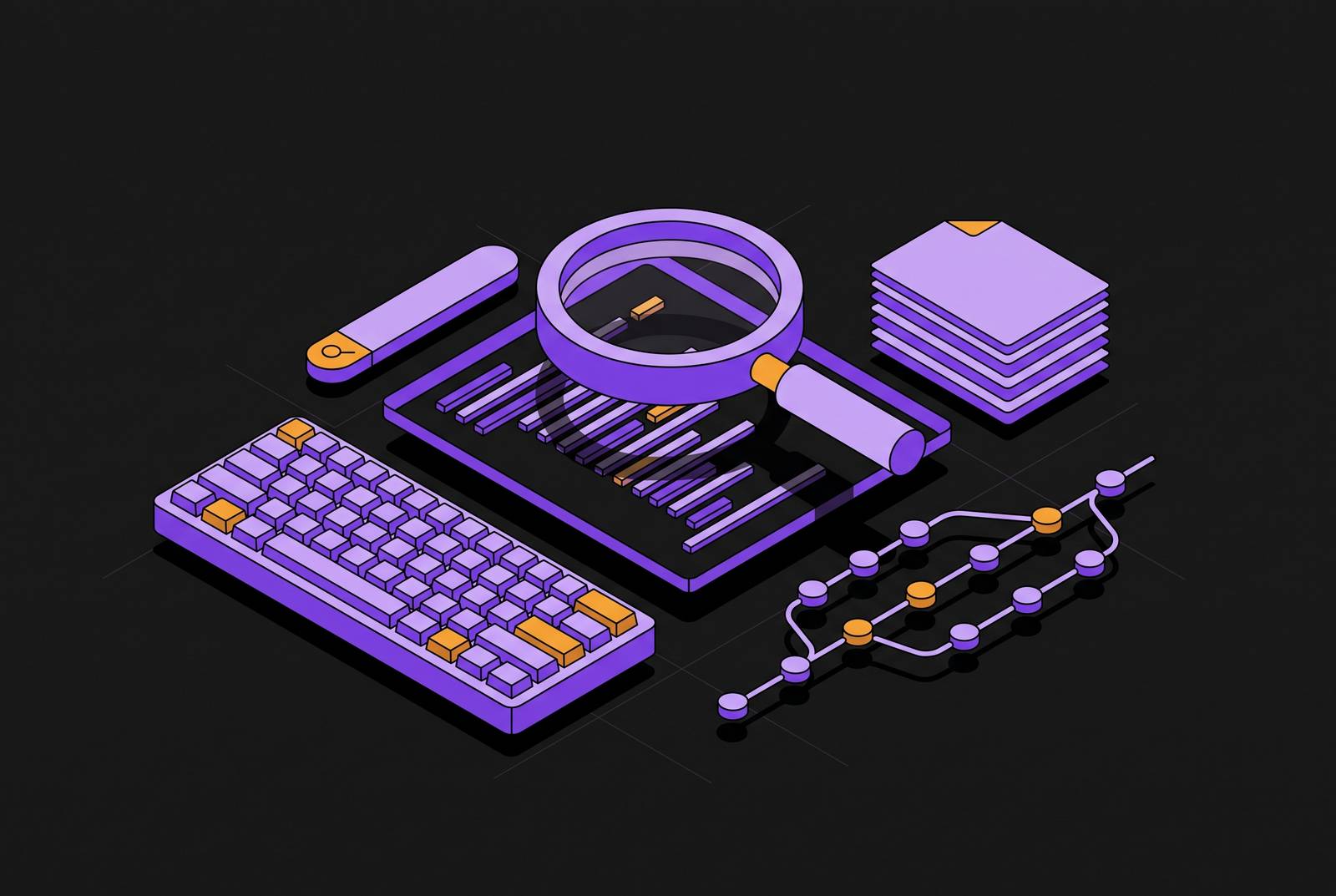
A branch is ready, the tests pass locally, and the engineer is one click from opening a pull request, but has no real way of knowing whether the change breaks an assumption made three services away. That gap between "my code works" and "my code is safe to merge" is where most first-PR anxiety actually lives, and it's a gap that code search tools are built to close before a reviewer ever sees the diff. Checklists for new hires reliably cover the IDE, the linter, and git credentials, but code search almost never makes the list, even though it's the tool that lets a new engineer trace the consequences of a change across a codebase they didn't write. The stakes have grown: a 2026 developer productivity guide finds that mid-size companies now face the problem too, since AI-generated code has pushed pull request volume up sharply enough that the bottleneck has shifted from writing code to understanding and validating it. Among the productivity problems code search is explicitly built to solve is the need to understand unfamiliar systems without pulling a teammate away from their own work, so configuring it before that first PR sets up every engineer to be self-sufficient from day one rather than interrupt-driven.
Code search versus IDE search and grep
IDE search and grep share a hard limit: they operate on whatever is checked out locally. The project boundary is also the search boundary. Code search is built to work across every repository, branch, commit, and diff an organization owns, and that cross-repo reach is precisely what an engineer needs before a first PR, when their local context of the codebase is at its thinnest. Consider the difference in practice. Grep can tell an engineer whether a string appears in the files on their machine. A proper code search tool can answer whether a deprecated function is still being called anywhere across the codebase, who changed the function last, and what the surrounding logic looked like at that commit, none of which grep or an IDE's built-in search was ever designed to resolve. The 2025 DevEx tools guide makes the structural point directly: enterprise codebases grow faster than most tooling anticipates, and a tool built to handle one repository will scale to handle many, while a tool built only for one repository never scales in the other direction. That asymmetry is the whole argument for configuring cross-repo search early rather than waiting until the codebase outgrows whatever search habit an engineer brought from a smaller team or a previous job.
The three configuration layers every engineer needs before opening a PR
The right setup before a first PR isn't a single tool choice but three distinct layers, each doing a different job in the workflow. The first layer is codebase search and navigation, the tool that answers what exists in the organization's code, where it lives, and how it connects to everything else, serving the engineer who is doing the searching. The second layer is agent context infrastructure, the protocol or tool that extends that same cross-repo awareness to AI coding agents, so that code an agent generates doesn't quietly violate an assumption the engineer never thought to state out loud. The third layer is code quality and security validation, the tooling that checks a change against known patterns of bugs, security issues, and style violations before a human reviewer ever opens the PR. These layers are complementary rather than redundant: tools like in-editor AI assistants, code search platforms, and PR reviewers each solve a different problem, and the sensible setup stacks them instead of picking one and hoping it covers for the others. The most common misconfiguration is treating one layer as sufficient for all three jobs. An engineer with excellent autocomplete but no cross-repo search still can't locate the service contract their change touches, and an engineer with cross-repo search but no agent context will get AI suggestions that look reasonable and violate conventions nobody wrote down.
Layer 1 tools: cross-repo code search and navigation
The right cross-repo search tool depends on three constraints that narrow the field before any feature comparison matters: deployment requirements, the scale of the repositories involved, and whether the organization requires code to stay inside its own infrastructure. On the enterprise, hosted end of the spectrum, Glean has demonstrated a concrete onboarding result, having reduced new engineer onboarding time at Shopify, and it offers strong enterprise search across both engineering and broader organizational knowledge. Elastic sits in a similar category of capability but a different category of effort. Slite's 2026 enterprise search guide names Elastic, alongside Lucidworks, as one of the go-to options for large-scale or on-premises deployments, and alongside Pinecone as an option for teams building custom AI search, though it demands more engineering investment to configure and maintain than a packaged solution would. For teams that want a codebase-native tool rather than a general enterprise search platform, there are options purpose-built as an AI-powered context layer and Q&A assistant for internal code, functioning less like a search engine and more like an expert on a team's own institutional knowledge. On the self-hosted and privacy-first end, Onyx stands out as an open-source, self-hostable enterprise search platform, dual-licensed with an MIT core and an Enterprise License for advanced features, offering a free community tier, more than 40 connectors, a full API, an MCP server, and support for any LLM, making it the strongest open-source choice for teams that need to connect Jira, Linear, Confluence, and code hosts all at once. Before committing to any Layer 1 tool, a few questions are worth answering directly. Does it index across every code host the organization actually uses, whether that's GitHub, GitLab, Bitbucket, or Perforce? Does it support the query types that matter, from symbol and regex search to structural and semantic natural-language search? And does it expose an MCP server or API so that AI coding agents can draw on the same index, which connects to Layer 2?
Layer 2 tools: giving AI coding agents cross-repo context through MCP
An AI coding agent restricted to the file currently open in an editor is, functionally, a sophisticated autocomplete engine. An agent with MCP access to a cross-repo search index can reason about callers, dependencies, and conventions it was never explicitly shown, so it actually understands the codebase it's working in instead of merely pattern-matching. The Model Context Protocol has become the standard connective tissue for this kind of context-sharing, linking tools like Cursor and Claude Code to databases, APIs, and version control systems, and every major agent runtime now supports it, including Claude Code, Cursor, GitHub Copilot, Gemini CLI, Codex, and Devin. The practical setup is straightforward: point the agent's MCP configuration at the same index the engineer already uses for human search, whether that's an MCP server exposed by a self-hosted code intelligence platform, Onyx's own MCP server, or a shared MCP server that several agent tools connect to at once. Among the agent tools worth configuring, Claude Code offers the deepest MCP integration available in a terminal-native format, able to read and write files, run shell commands, execute git operations, run tests, examine logs, query databases, and invoke external tools through MCP connections, with long-context models suited to multi-file repositories; Cortex's 2026 AI tools guide notes that it lets teams build AI-powered coding assistants using their own internal codebases. In-editor AI assistants are strongest where the editor itself becomes the center of AI-assisted work, particularly for in-editor autocomplete and context-aware generation, complementary to terminal-native agents like Claude Code rather than competing with them, with some teams configuring a shared MCP server so both tools draw from identical codebase context. For teams that need the entire agent loop running inside their own perimeter, Goose is an Apache 2.0 agent runtime originally built by Block and moved to the Agentic AI Foundation at the Linux Foundation on April 7, 2026, written in Rust and TypeScript and designed to run entirely on-machine with no cloud instance required. Continue served as an open-source, Apache 2.0 IDE extension for teams running local-model workflows, the right pick for IDE-integrated AI assistance pointed at infrastructure a team controls itself, though it was discontinued in June 2026 after being acquired by Cursor, with its repository now read-only. Separately, Context7 functions as an MCP server built specifically for documentation and API references, eliminating a common failure mode of hallucinated APIs by handing agents current, version-accurate documentation at the moment of inference. One of the highest-leverage, lowest-effort steps in this entire layer is the AGENTS.md file. Originally contributed by OpenAI and now adopted across Codex, Cursor, Devin, Factory, Gemini CLI, GitHub Copilot, Jules, VS Code, and Amp, it's the project-level instruction file that governs how every agent on a team interprets the repository, and an engineer should create or verify this file before opening a first PR, since it takes a matter of minutes and determines how every subsequent AI suggestion in that repo gets shaped.
Layer 3 tools: automated validation before the PR hits a reviewer
A bug or security issue that first appears during human review has already cost a senior engineer's attention, pulled away from their own work to catch a problem that earlier tooling could have flagged. Layer 3 tools exist to move that discovery back into the engineer's own workflow, before the PR is even opened. Two distinct jobs sit inside this layer. The first is static analysis and code quality: SonarQube is a self-hosted tool that checks code for bugs, security issues, and poor coding practices across 27 programming languages, integrating directly into CI/CD pipelines, and configuring it locally or in CI means the engineer sees those quality signals before pushing rather than after a reviewer finds them. The second job is AI-powered PR review with full awareness of the surrounding codebase. This kind of tool runs inside the PR workflow itself, reviewing and validating changes with context on the broader repository, which is particularly useful for catching assumptions an engineer didn't realize they were violating. For teams operating under formal compliance or security requirements, any tool in this layer should be evaluated for SSO and SCIM support, admin controls, usage analytics, private codebase handling, data retention policies, self-hosting or single-tenant deployment options, model and provider controls, audit logs, and enterprise code host support, all of which are infrastructure-level decisions made at the organizational level rather than left to individual preference.
The onboarding dividend: why this setup helps more than the engineer who configures it
An engineer who has already configured these tools before their first PR is less likely to interrupt a senior colleague with a "where does X happen?" question, and that reduction in interrupt-driven knowledge transfer compounds across a team. Understanding unfamiliar systems without asking a teammate is one of the central workflow problems AI developer tools are meant to solve. The Faros AI research brief found that engineers newer to a company adopt AI tools at higher rates than their more tenured peers, precisely because they are the ones most often navigating codebases they don't yet know. This kind of setup resonates most with exactly the engineers who need it most, and adoption should follow naturally if it's built into onboarding rather than offered as an optional extra. The counterpart to that finding is a structural problem: DX's Q4 2025 impact report found that the most senior engineers, the people who function as the primary knowledge transfer nodes on any team, have the lowest rates of AI tool adoption despite reporting the benefits those tools offer. Put together, these two findings describe a team where the engineers most willing to adopt new tooling are the least experienced, and the engineers everyone else depends on for answers are the hardest to reach through tooling alone. Configuring code search, agent context, and validation layers before a first PR doesn't just make one engineer faster. It reduces how often that engineer needs to reach for the one resource on the team that is scarcest.