How to Trace a Feature Across a Distributed Repository Structure on Day One
A unified index traces features across repository boundaries faster than grepping each repo by hand.
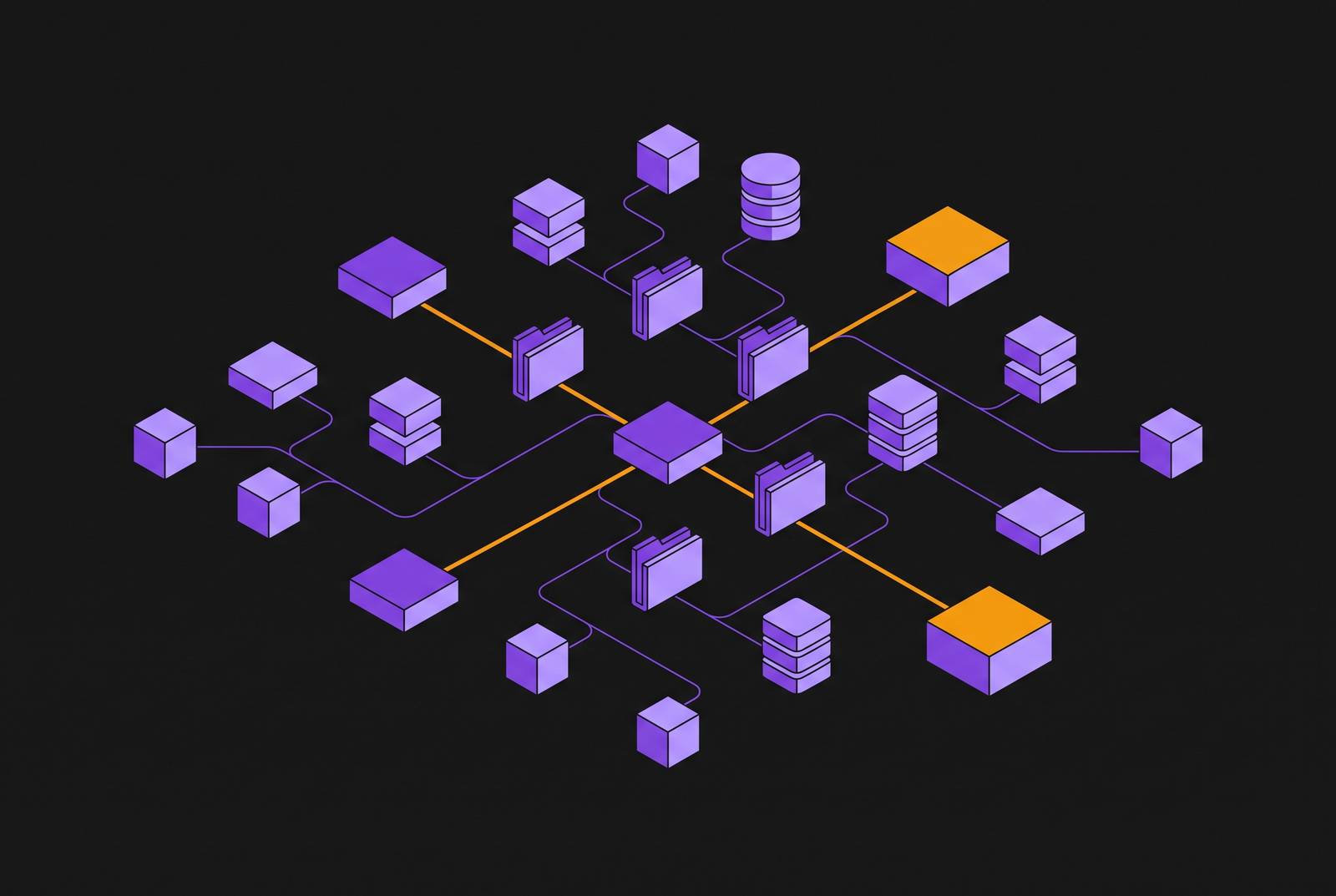
A new engineer tracing a feature across a distributed repository structure on day one needs a unified, symbol-aware index spanning every repo the feature touches, not a faster way to grep. The method below walks that index outward from a feature's entry point, across repository boundaries, through async dependencies and shared data models, into the tickets and decisions that explain why the code looks the way it does, and finally through an AI agent that verifies the resulting map against the real files. Each step produces something a second engineer can check, which is what separates a durable map from a set of notes one person made while poking around.
Why tracing a feature across repos on day one is structurally hard
When a feature spans a frontend repo, one or more backend services, a shared library, and a data layer, no single repository holds the full picture. That is a structural fact about how the code is organized. "Find in files" assumes the thing you're looking for lives inside the files you're searching, and in a distributed system that assumption breaks the moment a call crosses into another repo.
The shift toward microservices and multi-platform architecture made this worse, not better, for anyone trying to search their way to an answer. A shared utility function consumed by a dozen services turns a text search into a pile of noise instead of a signal, because plain text search cannot tell a live call site from a comment, a log message, or dead code left over from a refactor two years back. It returns occurrences of characters. It does not return relationships between code entities, which is the actual thing a new engineer needs.
The manual workaround, opening each repo in turn, running a separate search in each, and stitching the results into a call chain by hand, is slow and also produces a map nobody else can check. A map built that way lives in one person's head and their scratch notes, not in a form a second engineer can verify against the actual code. That's how senior engineers end up as the de facto search engine for every new hire, a role that gets more expensive as headcount grows, since each new engineer repeats the same manual reconstruction the last one did, with no record left behind for the next. A unified, symbol-aware index spanning every repository at once closes that gap: tools like Sourcebot, a self-hosted code intelligence platform, index the full codebase and resolve symbols across repository boundaries, making the cross-repo mental model explicit and searchable for anyone on the team.
What symbol-aware search does differently from text search
Symbol-aware search works on the abstract syntax tree, not on raw characters. It parses source code into a structural representation that identifies what each element actually is, a function, a class, a variable, an exported type, and how that element relates to every other element across the full dependency graph. Text search has no idea what any of those things are; it just matches strings.
Doing this across repositories, rather than within one, takes a unified index that ingests code from every connected repo, resolves import chains between them, and treats a function exported from one package and imported into another as a single symbol, not two unrelated strings that happen to match. A text search for a common field name across a large enterprise system can return results scattered across comments, docstrings, variable declarations, call arguments, and test fixtures, often numbering in the thousands. Symbol search narrows that same query down to the specific data element and its actual usage across the dependency graph, cutting out everything that merely contains the same characters.
IDE-based tools run into a real limit here. They understand the current project and sometimes its declared dependencies, but they do not index the downstream consumers of the packages that project exports. That is precisely the direction a new engineer needs to trace a feature in: not "what does this project depend on" but "what else in the organization depends on this."
Before you start: what needs to be in place for the process to work
None of the five steps that follow work without one precondition: a single index that already spans every repository the feature touches. Skip that precondition and each step collapses back into manual repo-hopping, which is the exact problem this process exists to replace.
Sourcebot deploys as a single Docker container inside an organization's own infrastructure, connects to every repository across the org, and provides a symbol-aware, cross-repo search layer that engineers can query starting on day one. There is no procurement cycle to wait on and no code that leaves the network to get indexed. A free tier indexes real repositories, which lets an engineering team check that the index is complete and accurate before anyone has to make a purchase decision. Because the deployment is self-hosted, sensitive code never crosses an external network boundary, a detail that matters for any team whose repositories hold regulated, proprietary, or security-critical code.
Other tools cover related ground within narrower boundaries. GitHub's built-in code navigation supports symbol search inside a single repository, and its hosted code search runs on a backend built for repositories hosted on that instance, both useful within a single org's GitHub footprint but not built as a unified cross-repo tracing layer. Another source control platform offers source control and CI/CD tooling with code review and collaboration features built in, and it works as a starting point for search within a single instance of that platform, though it's similarly scoped to the repositories it manages rather than a unified index across an entire organization's repos.
Step 1, Identify the feature's entry point using a natural-language or symbol query
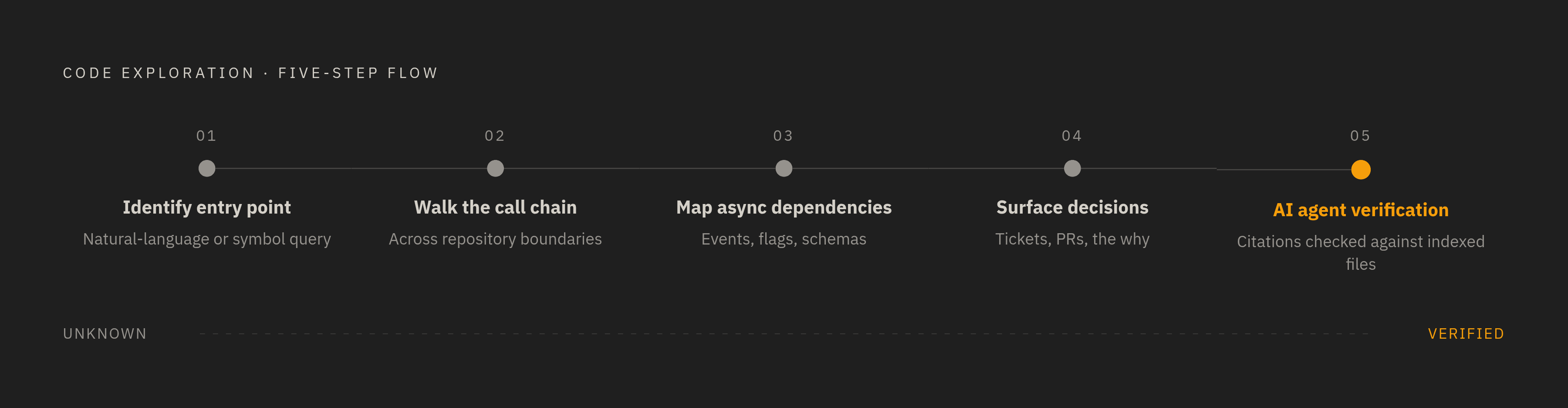
The place to start tracing a feature is never a directory tree or a README. It's the named symbol, endpoint, event, or UI action the feature exposes to the outside world, the thing a user clicks, the route a request hits, the event a system publishes.
A new engineer on day one usually doesn't know the exact file or function name involved, and that's fine: a natural-language query against the unified index, something like "where does the checkout flow start?", surfaces candidate entry points without requiring any prior knowledge of the codebase. A natural-language query against a unified code index, such as the search capability Sourcebot provides, lets a new engineer ask that question directly and get back a precise result: a function name, the repository it lives in, and the file path, instead of a page of grep output to sort through by hand.
From the candidates the query returns, pick the definition, the function or class that actually owns the behavior, rather than a reference to it or a test fixture that merely exercises it. Symbol-aware search distinguishes these cases explicitly, labeling a result as a definition versus a reference, which a plain text match cannot do.
Step 2, Walk the call chain outward from the entry point, one repository boundary at a time
This is where the actual cross-repo tracing happens, and where a unified index earns its keep over manual navigation. Consider a checkout event fired from a frontend repo. That event calls a pricing service living in a second repo, and the pricing service in turn calls a shared tax calculation library maintained in a third repo. Three repositories, one feature, and nothing in any single one of them tells the whole story.
At each node in that chain, the engineer does three things: confirm what the current function actually does, find every outbound call it makes, and identify which repository each of those callees lives in. Applied to the checkout example: the frontend event handler calls a calculatePrice function; that function turns out to live not in the frontend repo but in the pricing service repo, reached over an internal API; calculatePrice itself calls into a computeTax function, which resolves to a shared library repo imported by multiple services, not just the pricing service.
When a call like that crosses a repository boundary, from a frontend service into a backend API, from an API into a shared library, from a service into a data access layer, the unified index resolves the symbol directly. The engineer doesn't need to clone or open the second repository by hand to confirm where the call lands. A changed package namespace, an import from an external registry like npm, Maven, or PyPI that actually resolves back to an internal repo, or a service-to-service HTTP call whose endpoint matches a named handler sitting in another codebase entirely each signal that a boundary has been crossed.
Step 3, Map dependencies and surfaces that are not direct calls
A call chain captures the synchronous path through a feature, but event producers and consumers, queue listeners, and feature flags that gate whether a given code path even runs never appear as a direct function call. A map that stops at the call chain is a map that looks complete and isn't.
Shared data models, structs, schemas, database table definitions, often live in a repository of their own, imported by several services at once. A symbol search on the model's name surfaces every service that reads or writes that same structure, which a call-graph walk alone would never reveal, because those services share the same data shape without ever calling each other directly. The same search pattern works for configuration and feature flags: searching for a flag's string key as a symbol returns every codebase that checks it or sets it, which matters because a code path can exist in the repo and still be dead in production if the flag gates it off.
The output of this step is an annotated map: the synchronous call chain built in Step 2, plus the asynchronous consumers and shared models that round out the actual footprint of the feature. Without this step, a new engineer can trace a clean-looking call chain and still misunderstand what the feature touches, because the parts that don't call anything directly are often the parts most likely to break when the code changes.
Step 4, Surface the surrounding context: tickets, decisions, and PR history
Code records what a team decided. It does not record why they decided it. A new engineer who has traced a feature down to its exact files and dependencies can still make a change that reopens a debate the team already settled six months earlier, simply because nothing in the code itself says the debate happened.
Closing that gap means search that covers tickets and issues, PR descriptions and review threads, conversation context pulled from Slack and Teams, and documentation sitting in Confluence, Notion, or an internal wiki, all of it permission-aware and cited back to its source. Once the code map from Steps 2 and 3 exists, the practical move is to run a second query against that connected knowledge layer using the feature name or the primary symbol name as the search term, then read through the top results for any decision that constrains how the feature can be implemented or changed.
After this step, a new engineer can explain not just how the feature works but why it was built that way. That's the distinction between someone who read the code and someone who actually understands the system.
Step 5, Use an AI coding agent to verify the map and fill gaps
An AI coding agent, given access to the full codebase index rather than just a local checkout, can walk the dependency graph, list every file involved in a feature, and flag paths the engineer's manual trace may have missed. The value here is verification speed. The agent is not a replacement for the structured walk through Steps 1 through 4; it's a check on whether that walk was complete.
The design choice that makes this trustworthy is simple to state and easy to get wrong: the agent needs to read actual indexed files, not generate plausible-sounding answers from training memory. When an agent can point to the specific lines backing up a claim, a new engineer can verify that claim against the real codebase instead of taking a confident-sounding fabrication on faith. That's the direct answer to the hallucination risk that comes up with any AI coding tool: give the agent real files to cite, and check its citations the same way you'd check a colleague's.
Cursor now supports agents that can onboard themselves to a repository, understand the codebase, and operate inside isolated environments, which makes it a reasonable fit for running a verification pass over the map built in Steps 2 and 3. A useful verification pass depends on the agent having full codebase context behind it. A context layer like Sourcebot's, feeding an agent an index across every repository rather than the one sitting on an engineer's laptop, is what makes that verification pass actually check the whole system instead of the one corner of it the engineer happened to clone.
What the completed map should look like
The finished artifact is a documented trace: the entry point, the call chain across repositories with every boundary marked, the async consumers and shared models from Step 3, the key tickets and design decisions from Step 4, and the files the agent flagged in Step 5 as relevant but not yet reviewed. Every node in that map links to an actual file in a specific repository, which makes it checkable.
That checkability is what makes the map worth more than one engineer's personal notes. A second engineer can follow it without having to retrace the whole thing from scratch. A senior engineer can review it in minutes instead of fielding the question from scratch over Slack. The same map can become the starting point for a code review, an impact analysis before a larger change, or an onboarding document handed to the next new hire who touches the same feature.
Running this process for every new feature an engineer encounters is how cross-repo mental models get built on purpose, rather than accumulating by accident over months of pairing with whoever happens to know that part of the system. And the process isn't limited to engineers. For a PM, a support engineer, or an architect, the same natural-language query run against the same unified index answers direct questions about what a feature does and which services it touches, without needing a senior engineer to sit down and translate the codebase into plain language first. The method described here is a repeatable process that any person in the organization, technical or not, can run against any feature, on day one or two years in.