Reducing Engineer Interruptions During New Hire Onboarding
Self-hosted code intelligence can answer onboarding questions without interrupting senior engineers.
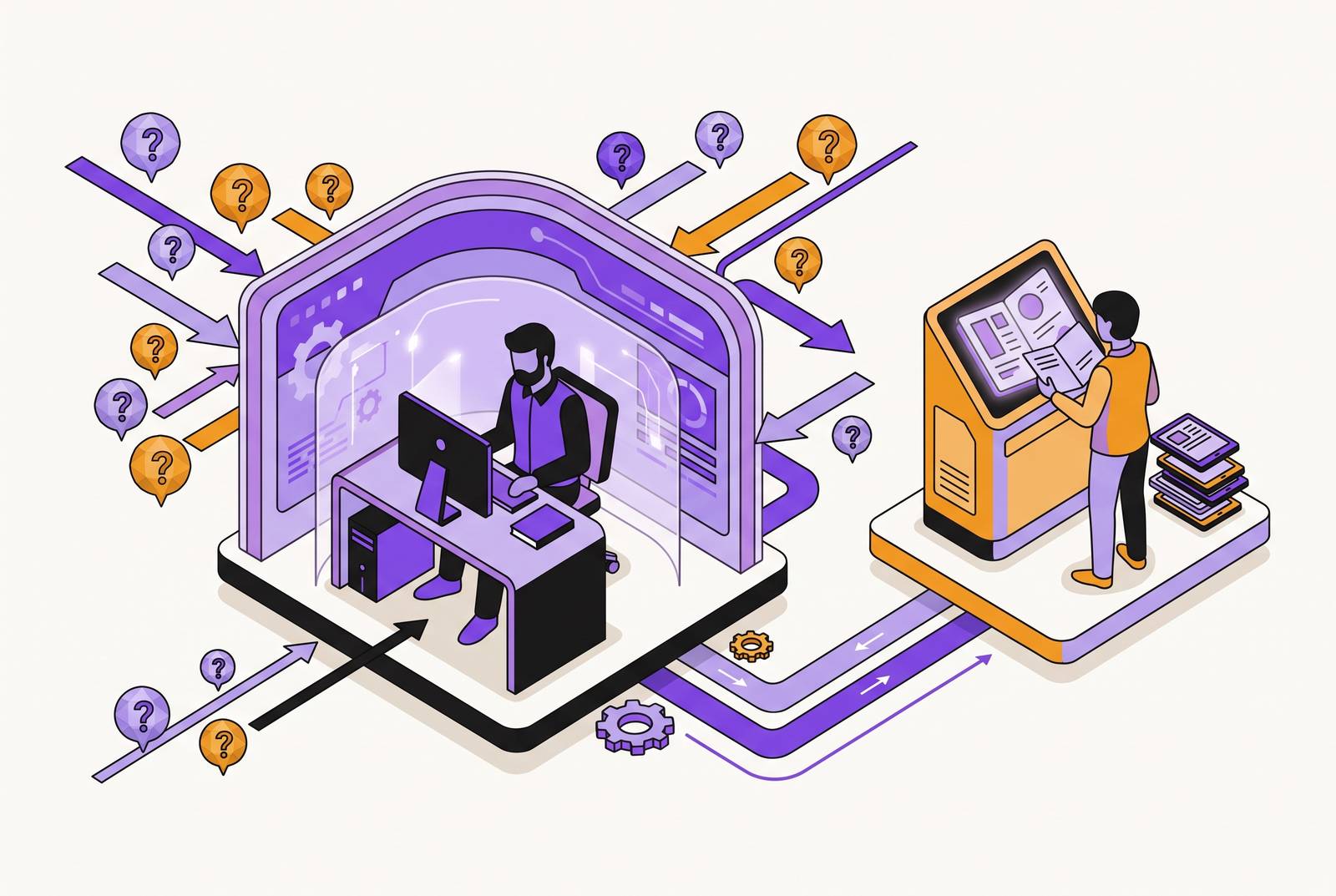
A new hire stares at a function call for twenty minutes, finds three plausible owners, and picks none of them. The tab switches to a chat app. A message goes to the senior engineer two desks over: "Quick question, do you know where this gets called?" That exchange, repeated dozens of times a week across a growing team, is the predictable output of a codebase that cannot answer questions on its own. A human has to stand in as the search interface. Senior engineers hold the map because nobody else can build one fast enough, and the system routes every navigational question to whoever happens to have one in their head.
The logic that drives a new hire to interrupt is sound. Weighed against an hour or more of unguided digging through unfamiliar services, a five-minute chat message is the obviously efficient choice, and any reasonably rational person in that position would make it. The questions new hires need answered, like which service owns a piece of business logic, why a deployment pipeline is shaped the way it is, or what architectural decision led to a particular pattern, are rarely surfaced anywhere in the code itself. Without a guide, that context exists only in the heads of the people who lived through building it.
The cost of senior engineer time spent on onboarding questions
The structural problem has a financial shadow that most engineering organizations never calculate directly. Onboarding a software engineer to full productivity typically costs a substantial share of that engineer's annual salary, and the accepted range for reaching full productivity runs six to nine months, with the ramp itself as the dominant driver of that cost. Almost none of the standard onboarding cost models price in what happens to the people doing the teaching.
Call it senior mentor drag: the most experienced individual contributor on a team routinely spends 20 to 40 percent of working hours supporting a new hire through the first three months. That percentage, multiplied by a senior engineer's fully loaded hourly cost, accumulates into a substantial hidden expense that almost no onboarding budget line captures, because it was never priced as a cost to begin with.
The compounding runs in two directions. If that senior engineer is also the person responsible for a quarterly roadmap milestone, every hour absorbed by onboarding questions is an hour of roadmap output that does not get produced, not merely an hour logged against a different task. And the true cost of an interruption extends well past the length of the interruption itself: once a senior engineer is pulled out of deep work to answer a question, the return to that prior state of focus takes measurably longer than the conversation did. That recovery tax is what makes onboarding interruptions structurally different from ordinary collaboration costs. A two-minute question can cost twenty minutes of lost depth on the other side of it.
Why documentation and runbooks don't close the gap
Documentation works exactly as well as it is accurate, current, and easy to find, and all three of those conditions erode quickly once a codebase grows past a certain size or speed of change. The standard advice to "just write better docs" is not wrong so much as incomplete. Good documentation measurably shortens the time it takes new engineers to reach productivity, and organizations that invest in it see that return directly. What that return does not cover is everything docs cannot keep up with.
When onboarding materials point to deprecated APIs, outdated architecture diagrams, or internal tools nobody uses anymore, the new engineer's first week fills with corrections. Each discrepancy they find triggers another question, and each of those questions still lands on a person, because the document that was supposed to prevent the interruption is the thing that caused it.
Documentation describes a fixed snapshot of a system that keeps moving. A codebase is a living system, and the two drift apart continuously, with the fastest drift concentrated in exactly the areas that change the most, which also tend to be the areas a new hire most needs explained. Even documentation that happens to be accurate solves only half the problem. A new hire who doesn't know the right term, service name, or file to search for cannot find an answer that technically already exists, so the question still travels to a senior engineer regardless of how well the wiki was maintained. Documentation and runbooks earn their keep, but they were never built to close the discoverability gap on their own.
What "making the codebase navigable" requires
Go back to the new hire staring at that function call. The fix is not a better onboarding doc; it's a system that can answer the question the doc was always going to miss. Making a codebase navigable means a new hire can ask where a function lives, what service owns it, or why an architectural decision was made the way it was, and get a direct answer without pulling a person away from their work.
That answer has to come from the code itself rather than from a document that might have gone stale the week before. Searchable code is more durable than searchable documentation for the simple reason that code is the ground truth; it cannot drift from itself. A self-hosted code intelligence platform like Sourcebot, which indexes the full codebase and enables natural-language search across repositories, can surface architectural and ownership context directly to new hires, turning the codebase itself into a navigable reference instead of a black box only senior engineers can interpret.
Search by itself is not sufficient either. A new hire who doesn't know the exact file name, service name, or internal terminology cannot search effectively against a traditional code index, so the system needs to support natural-language queries against the full repository graph, not just keyword matching against known strings. Ownership and architectural context matter as much as the code itself: new hires need to know who owns a given service, how it connects to the rest of the system, and where it is safe to make a change, which is the navigational layer senior engineers carry in their heads and nowhere else. Embedding AI tools into onboarding lets new hires ask these questions and get answers about architectural decisions without pulling a peer away from their own work, when those tools can see the whole codebase.
The limits of AI coding agents without full codebase context
AI coding agents are already part of most onboarding plans, and for good reason: they can explain code, suggest fixes, and answer syntax questions on demand. The limitation appears at the edges of what the agent can see. An agent restricted to the files open in an editor, or to a single local branch, cannot answer questions about the broader system, and those system-level questions are precisely the ones a new hire most needs answered.
Large language model agents also don't retain context across sessions on their own. They forget a project's conventions, repeat mistakes already corrected once, and cannot hold a coherent picture of a large system unless that context is explicitly fed to them and kept current. Without a persistent layer of codebase knowledge behind the agent, every session restarts from close to zero.
The benefit these tools provide during onboarding is genuine, but it is not distributed evenly. New hires without guidance on how to prompt an agent effectively see smaller gains from it, while engineers who already understand the codebase extract far more value from the same tool. The gap between those two groups is the one onboarding exists to close, and the tools as typically deployed leave it just as wide as before. An agent that produces working code a new hire doesn't understand creates a new kind of dependency, where the engineer can ship something but cannot debug or extend it later. That's a navigability failure of its own, and it compounds the longer it goes unaddressed.
Context infrastructure, MCP connectors, repo-wide search, and indexed knowledge bases
What sits between a new hire's question and a useful answer is a layer of context infrastructure that gives both agents and humans queryable access to the full codebase, across every repository, in real time. This is the architectural piece that makes the earlier requirements achievable.
A context protocol lets AI tools pull in project context from outside the code itself. Atlassian's official MCP server gives AI tools secure, real-time access to Jira, Confluence, Jira Service Management, Bitbucket, Compass, and Loom. Linear hosts its own official remote MCP server, launched May 1, 2025, letting agents access Linear data including issues, projects, and comments. With connectors like these in place, a new hire asking why a payments service works the way it does can get a single answer that spans the code itself, the ticket history behind it, and the architectural decisions recorded along the way, instead of three separate searches across three separate tools.
None of that works without coverage. Repo-wide search indexed across every repository in an organization is the precondition for any of it functioning: an agent or a person can only navigate what has actually been indexed, and partial coverage reproduces the exact gaps that make senior engineers indispensable. The practical shape of this looks like a new hire or an agent typing a question such as "who owns the payments service and when was it last changed" in plain language, getting an answer grounded in the real code and ticket history, and following that answer straight into the relevant file, service, or ownership record, without a chat message in between.
The data privacy constraint that shapes how context infrastructure gets deployed
Full-codebase indexing requires sending code somewhere to be processed and queried, and for most enterprises the real engineering question is whether that somewhere sits inside the company's own network or outside it. This is not a minor implementation detail; it determines which tools a security team will even consider.
In regulated industries, defense, healthcare, and finance among them, source code leaving the network is treated as a compliance dealbreaker. For teams operating under those constraints, the context layer has to be self-hosted, or the tool is simply not usable regardless of how good its search quality is. The same caution extends well beyond regulated sectors. A company's codebase is its most sensitive intellectual property, and routing that code through a third-party cloud service introduces exactly the kind of risk security teams are built to block.
Self-hosting doesn't have to mean standing up a complicated new piece of infrastructure. A platform that ships as a single Docker container, deployable on a company's own infrastructure, whether on-prem or in its own cloud, can provide the same indexing and natural-language query capability without any code ever leaving the deployment. Sourcebot follows that model, supporting code hosts including GitHub, GitLab, Bitbucket, Azure DevOps, Gerrit, and Gitea, both cloud and self-managed, which keeps the self-hosted option practical rather than theoretical for teams that have no other choice.
The impact of a searchable codebase on new hires, senior engineers, and non-engineers
Once a codebase becomes independently navigable, the interrupt-routing pattern that defines most onboarding simply breaks. A new hire's question about where something lives, what owns it, or why it was built a certain way goes to a search interface instead of a person, and the answer it returns is grounded in the actual code rather than in someone's memory of it from eighteen months ago. That answer is available at two in the morning or two in the afternoon, and asking it carries no social cost.
Senior engineers get the corresponding time back. The interruptions that remain are the ones that genuinely require human judgment, architectural tradeoffs, code review, context that truly lives nowhere else, rather than the much larger volume of questions about where something is located. That shift alone recovers a meaningful share of the 20 to 40 percent of working hours onboarding otherwise consumes from a team's most experienced engineer.
The same searchable layer extends past engineering. Product managers, support staff, and technical writers gain a path to codebase knowledge they never had before, because the questions they previously had no way to ask on their own now have somewhere to go. The reduction in interrupt load doesn't stop at onboarding; it carries into the team's everyday operation long after a new hire's first ninety days are over. Sourcebot indexes every repository in an organization into one searchable layer, deployable as a single Docker container inside a company's own infrastructure, so that engineers, agents, PMs, and new hires alike can query it in natural language and get an answer from the codebase directly. The senior engineer stops being the default search interface as the team's knowledge moves into a place everyone can reach.