The First-Commit Checklist Engineers Actually Need Before Touching the Codebase
Engineers need system understanding, not just environment setup, before their first commit.
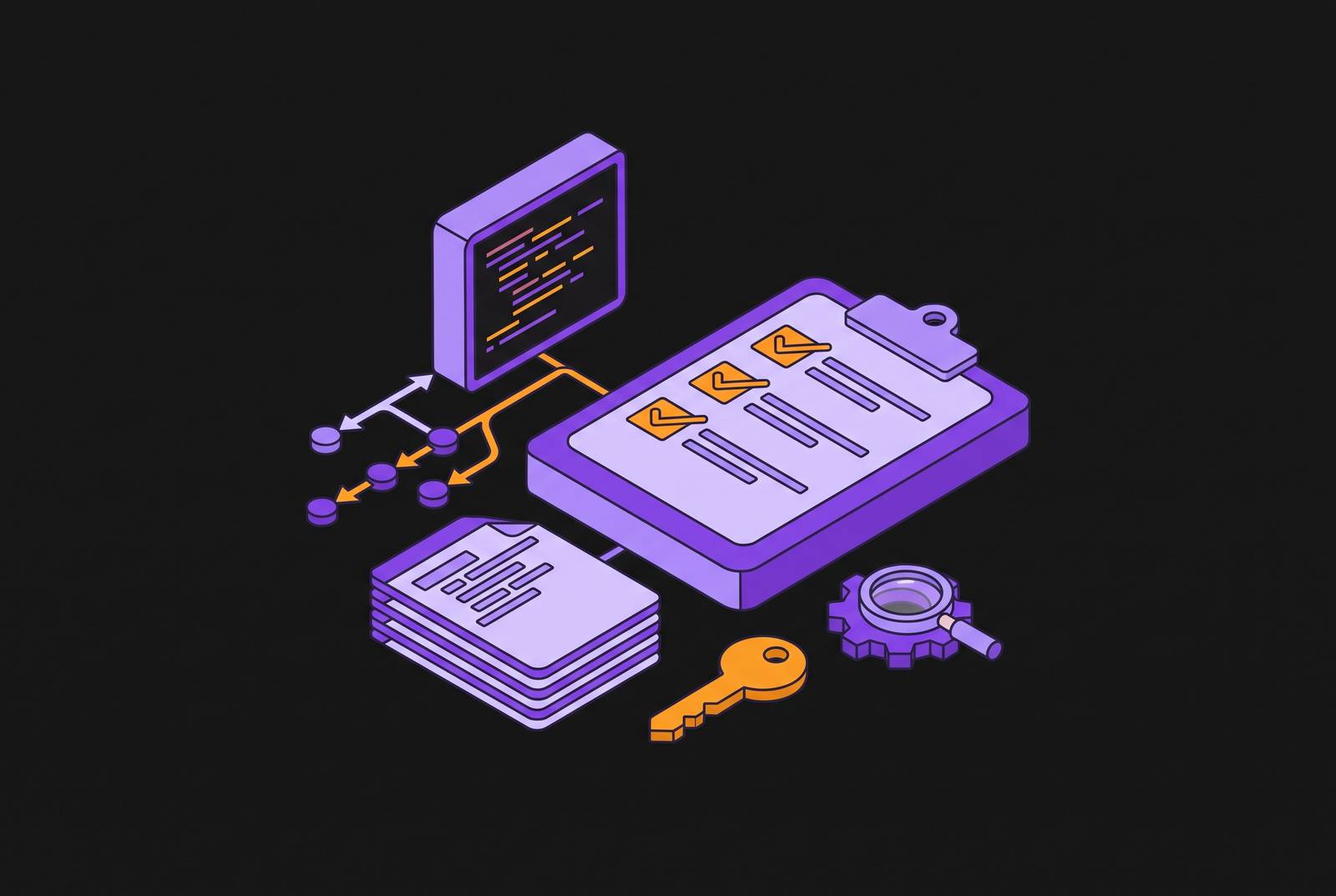
The standard pre-commit checklist asks whether an engineer has repo access, a working IDE, SSH keys, and a passing test suite. It never asks whether that engineer understands the codebase well enough to make a safe change, but a first commit from someone who lacks that understanding hurts rather than helps.
Why the standard pre-commit checklist fails engineers
Repo access, environment setup, and a green test suite confirm that an engineer can run code. None of that confirms the engineer understands what the code does, who owns it, or what breaks when it changes. A checklist built entirely around logistics treats onboarding as a provisioning problem, when the harder problem is structural: does this person know enough about the system to make an intentional change rather than a lucky one?
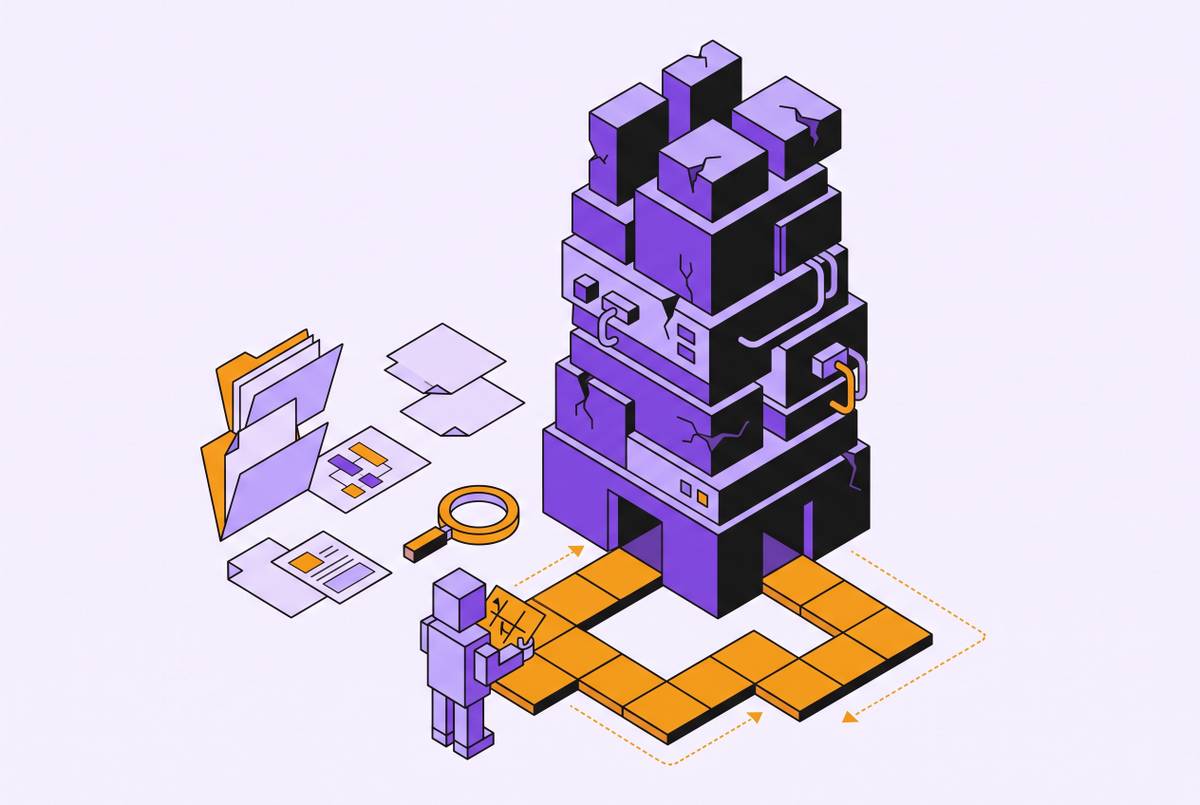
The failure mode that actually costs teams time is a change that compiles, passes its tests, and looks correct in isolation, but quietly touches a shared abstraction, crosses a service boundary nobody flagged, or edits a file whose churn history signals coupling that isn't visible anywhere in the code itself. Environment setup will never catch this, because the problem is whether the engineer can see the system, not whether the engineer can run it.
This gets worse at scale, not better. At most enterprises, a single feature change routinely means tracing logic across several repositories before finding the line that actually needs to move, and that condition is normal rather than exceptional. Valorem Reply's research puts the industry average time-to-productivity for a new engineer at 2 to 4 weeks, and that lag has two costs attached to it. The new engineer pays in avoidable mistakes, because they don't yet know what they don't know. Senior engineers pay in interrupted time, because they end up re-explaining the same system boundaries, one conversation at a time, to whoever just joined.
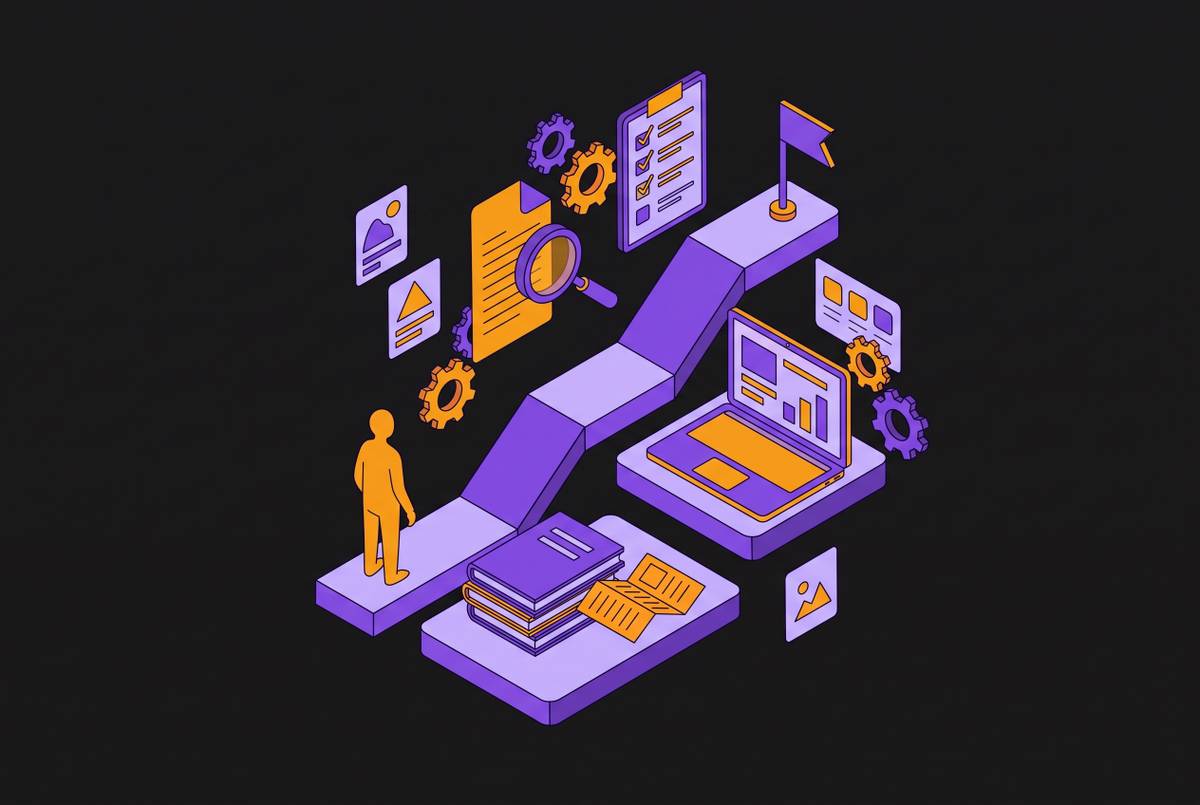
The fix is a different checklist, one built around codebase context instead of logistics. Every section that follows is one item on that list.
What enough context to make a safe change requires
Readiness for a first commit comes down to four answerable questions. Which module owns the behavior being changed? Which files tend to change alongside it? Which other teams or services consume what's being touched? And which parts of the code look wrong but are actually correct, for reasons documented somewhere the engineer hasn't found yet?
These four questions work as a diagnostic. An engineer staring at a ticket should be able to check each one against their own understanding and know immediately which answers they're missing. Not knowing the answer to the first question means the change risks landing in the wrong layer of the system. Not knowing the second means the change is half-finished before it starts, because its usual companion files never got touched. Not knowing the third means the change might work perfectly in its home repo and still break a service two teams away. Not knowing the fourth means the engineer might "fix" code that was never broken, undoing a deliberate tradeoff someone made for reasons the code itself doesn't explain.
None of these four questions gets answered by setting up a laptop. They get answered by reading the codebase's structure, its history, and its documented decisions, in that order, which is exactly the sequence the next four sections walk through.
Reading the module map: identifying ownership and service boundaries before editing anything
Before any edit, the first action is mapping which modules own which behaviors, so the engineer knows whose territory they're entering. In a well-structured repository, this means reading the top-level directory listing not as a list of folders but as a map of domains: each top-level package or service directory marks a potential boundary, and the task is to name what each one owns before touching any of them.
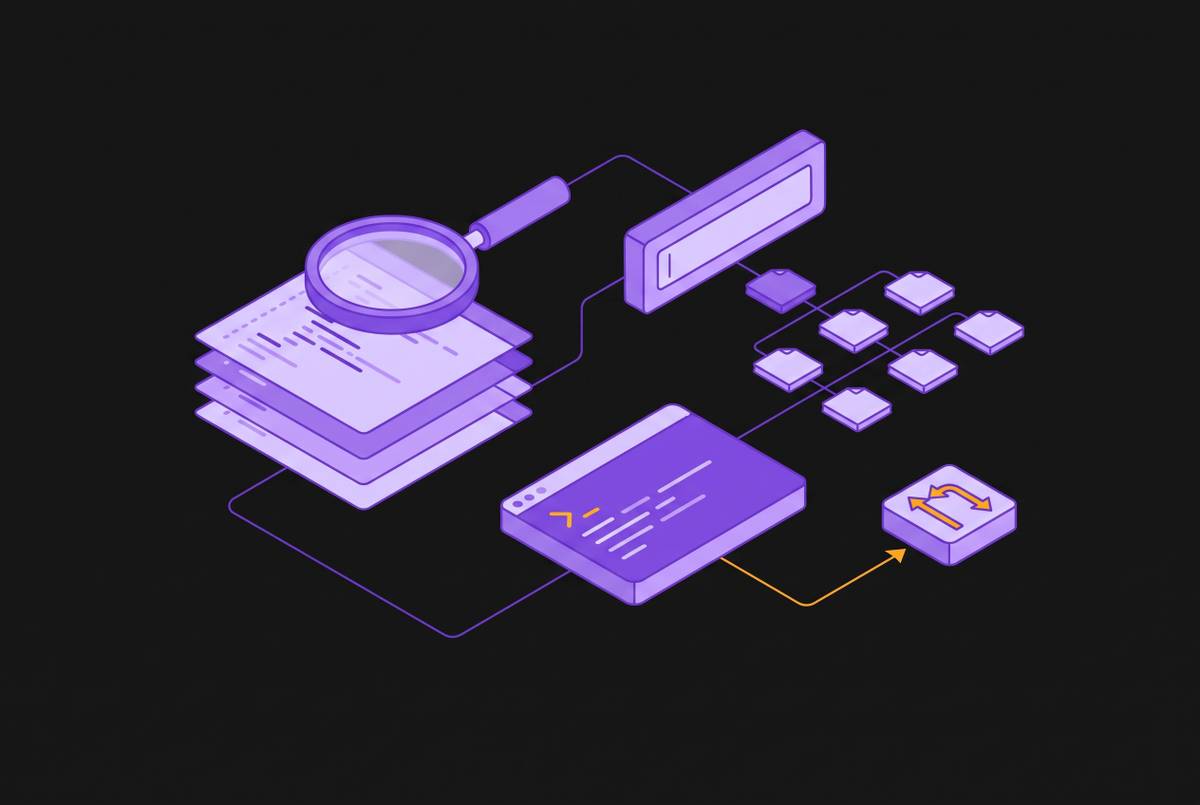
Structured codebase analysis tools produce exactly this kind of output as a first-class result. Architecture analysis of this sort identifies the tech stack from manifests and lockfiles, maps system boundaries, generates dependency graphs, and attributes module ownership, giving an engineer the inputs needed to make an intentional edit rather than a guess.
In a multi-repository system, the map has to extend past a single repo's boundaries. The checklist item becomes tracing which repository holds the canonical version of a shared abstraction, since editing a local copy without knowing a canonical one exists elsewhere introduces silent divergence. Sourcebot, a self-hosted code intelligence platform, addresses this by giving engineers and agents search and navigation across every repository in an organization from one interface, so an engineer can directly answer which repository owns a given piece of cross-repo logic instead of guessing.
Entry points, configuration hubs, and shared utility files deserve an explicit flag during this mapping step, because these are the files that break things silently when modified without coordination, rather than failing loudly in a test. Key file annotation, surfacing the roughly 20 most important files in a codebase and explaining why they matter, is a named output of structured onboarding tooling for this exact reason: an engineer shouldn't have to derive this list from scratch by trial and error.
The concrete output at this stage is a short, named list: the modules in scope for the first task, a named owner (team or person) for each, and at least one entry point or canonical file per module to serve as a reading anchor.
Tracing co-change patterns in git history to find hidden coupling
Architecture describes what the system was designed to do. Git history describes what actually happens to it, and the space between those two things is where first-commit mistakes live. Files that consistently show up together in commits are coupled in practice, whether or not the architecture diagram shows a line connecting them, and an engineer who changes one without checking the other has completed half a change without realizing it.
The concrete action is a co-change query. Before touching a file, pull up the git history for that file and read the list of files that most frequently appear alongside it in the same commits. Any file on that list the engineer hasn't yet read is a gap in their understanding of the change they're about to make.
This signal is too noisy to pull manually from raw git logs at any real scale; hotspot analysis and churn data are dedicated features in codebase intelligence platforms rather than something engineers derive by hand. High churn on a file is a second, related signal worth reading alongside co-change data. A file that changes constantly is either under active development, so expect conflicts and coordination overhead, or it's being repeatedly patched, so expect fragility. Either way, the file isn't safe to edit blind.
The output of this step is a short list, specific to the files in scope for the first task: their most common co-change companions, and a churn classification of stable, active, or fragile. That classification tells the engineer how wide a blast radius to expect before they write a single line.
Finding cross-team and cross-service dependencies before the change, not after
The most expensive first-commit mistakes rarely originate inside the repo being edited. They come from changing something another team's service depends on silently, in a way the file itself gives no indication of. A field consumed by four other services spread across separate repositories, or a shared library version a downstream service has pinned to, cannot be discovered by reading the one repo in front of you. No single developer's machine can surface this, no matter how carefully that developer reads the code.
Discovering these dependencies before a commit, rather than during code review or after a production incident, requires structured cross-repo search rather than memory or documentation that describes intended dependencies instead of actual ones. Natural-language code search across an organization's full codebase, the kind available through platforms like Sourcebot, lets engineers and their AI agents ask which services import a given module or which endpoints call a given function, and get a complete answer before the first commit rather than a partial one after.
The concrete action: for every public interface, exported function, or API endpoint in scope for the first task, search across every repository in the organization for consumers, then read the ownership annotation attached to each one. This is a fast lookup that stays fast precisely because it happens before the change rather than as a postmortem exercise.
The output fits in a few lines: a named list of downstream consumers for each interface in scope, with team ownership attached to each, short enough to paste into a pull request description as a "reviewed impact" note.
Reading decision records to distinguish intentional code from code that needs fixing
The most common waste in a first contribution is cleanup. An engineer sees code that looks wrong and "fixes" it, not realizing the code reflects a deliberate decision, a migration still in progress, a security constraint, or a performance tradeoff that leaves no trace in the code itself. Architecture Decision Records and inline decision comments exist for exactly this situation. Martin Fowler's writing on ADRs describes them as a record that lets people, months or years later, understand why a system was built the way it was, and that "why" is a question no amount of reading the code alone can answer.
Strong engineering teams document service boundaries, key dependencies, deployment paths, and the reasoning behind code that looks ugly but is intentional. The signal that this documentation is missing appears in a specific pattern: if a staff engineer has to explain the same subsystem three separate times in a month, that explanation belongs in writing instead of in a third Slack thread.
This is the one checklist item where no tool fully substitutes for a conversation with whoever made the original decision. An AI coding agent, or any code-search tool, can locate the ADR, the linked ticket, or the PR discussion that explains the oddity, but it can't originate the explanation if no record exists. Its role here is retrieval. Internal knowledge bases that capture prior Q&A alongside code context exist specifically to make that retrieval self-serve rather than interrupt-driven, so the lookup doesn't require pulling a senior engineer away from their own work a fourth time.
The concrete action: before editing any file that looks structurally odd, search for an ADR, a ticket-referencing comment, or a linked PR discussion that accounts for it. The output sorts every flagged piece of code into one of three buckets: explained by a decision record, explained by a team member (and then documented, so the next engineer doesn't have to ask again), or genuinely worth fixing, with that fix scoped into its own pull request rather than bundled into the first task.
What AI coding agents need from this checklist
An AI coding agent running on a developer's local machine inherits the exact same blind spots as a new engineer reading one repository in isolation. It cannot see ownership across other repos, it cannot see co-change patterns outside the commit history it has access to, and it cannot see which downstream services consume the interface it's about to modify. This is a limitation of what the agent can see at all: the information a safe change requires lives in the codebase's structure, its history, and its ownership metadata, and a local agent has none of that by default, no matter how large its context window is.
Coding agents without access to a cross-repo context layer see only the repos sitting on the local disk. A cross-repo context layer addresses this gap by giving agents context across every repository in an organization through a standard protocol for connecting agents to external tools and data, so the same structural questions this checklist has been building, ownership, co-change companions, cross-service consumers, become questions the agent can answer directly instead of questions only a human can resolve.
The division of labor that makes this safe is specific. Static analysis and code intelligence tools discover the structural facts: who owns what, which files are coupled, who consumes which interface. The AI agent reasons over those facts and proposes a change. MCP is the connective layer that moves the facts from the indexing system to the agent. The harness, the tool running the agent, decides whether the agent is allowed to act. The context layer decides whether that action is actually correct. Neither one substitutes for the other, and a checklist that skips the context layer leaves the agent guessing in exactly the way an under-briefed new hire would.
Pointing an agent at a first task, in other words, means the same four questions apply as they would for a human: module ownership, co-change companions, cross-service consumers, decision records. The agent needs a path to systems that can answer them. It cannot answer them from the files on disk alone.
Agent configuration files are now part of the codebase security surface
In any repository where AI coding agents operate, the agent configuration files, .claude/settings.json, .mcp.json, and their equivalents, belong on the pre-commit checklist as code to review: treat them as active code. They function as execution vectors.
A malicious Hook injected into a repository's agent configuration can execute the moment a developer opens the project, immediately on accepting the trust dialog and without any per-hook confirmation. A compromised configuration file sitting in a shared repository becomes a supply-chain risk for every engineer who clones it, whether or not they ever run the agent themselves.
MCP server configuration carries a related risk. Project-scoped MCP files are meant to be checked into version control so a team can share setup, but an inline credential placed in that file gets pushed and pulled along with everything else, copying the token into repository history and onto every machine that pulls the configuration down.
A pre-commit review in an agent-enabled repo should include a short, specific set of checks: agent configuration paths added to the code review checklist with the same scrutiny given to any dependency file; auto-approval settings for MCP servers blocked by default; MCP server package versions pinned and verified the way any other software dependency would be; and credentials confirmed to live in environment variables or a secrets manager reference, never typed directly into a committed configuration file.
Sources
- Claude-Skills/engineering/codebase-onboarding/SKILL.md at main · borghei/Claude-Skills
- Code understanding for humans and agents
- Change coupling from Git history: "usually changes together with X" and a missed-companion signal · Issue #6 · phillipecardenuto/repo-understanding
- Indexer · git history scanner — unblocks Hidden coupling, Ownership, and Complexity's churn axis · Issue #224 · sensei-hq/sensei
- GitHub - rexeus/codeheat: Find hotspots and change coupling in a git repository — a treemap for humans, JSON for agents.
- Kill the Clones - ACCU