Giving AI Coding Agents Cross-Repository Search so They Stop Asking You for Context
AI agents safely handle multi-repository changes when they can query cross-system dependencies.
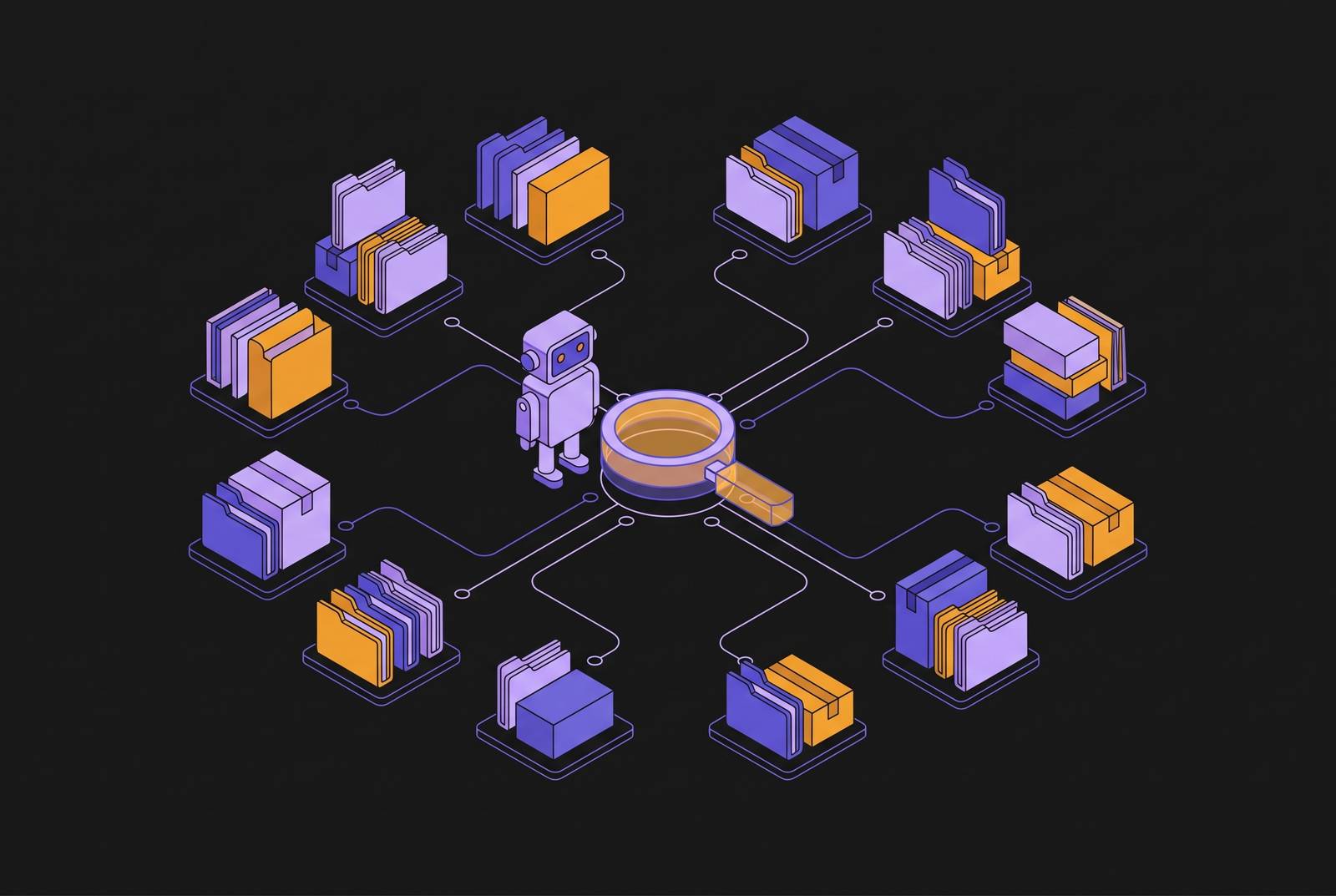
Cross-repository search makes engineering onboarding easier and helps AI coding agents act safely because both can look up current dependencies, contracts, and change history across the company’s codebase. A queryable context layer outside any agent session, delivered through MCP, lets engineers share that knowledge without having to explain it over and over. It reduces the need to reconstruct code relationships manually, while leaving architectural judgment and mentorship with people.
Why agents that can execute code still fail at multi-repository tasks
An agent asked to deprecate an API field can inspect every file in the repository it is editing. It cannot necessarily see which services elsewhere consume that field, which teams own them, or whether the field passes sensitive data into a third-party integration. The checkout is not the whole system. The dependency graph needed to assess the change’s safety extends beyond the repository boundary and therefore beyond the context available to the agent.
Deep Agentic Search for Repository-Level Code Question Answering describes the underlying constraint. A language model has a bounded context window and a fixed store of parametric knowledge, neither of which contains a faithful, current copy of the organization’s repositories. Execution capability does not remove that constraint. An agent can make a plausible local edit without knowing enough to make a safe cross-system change.
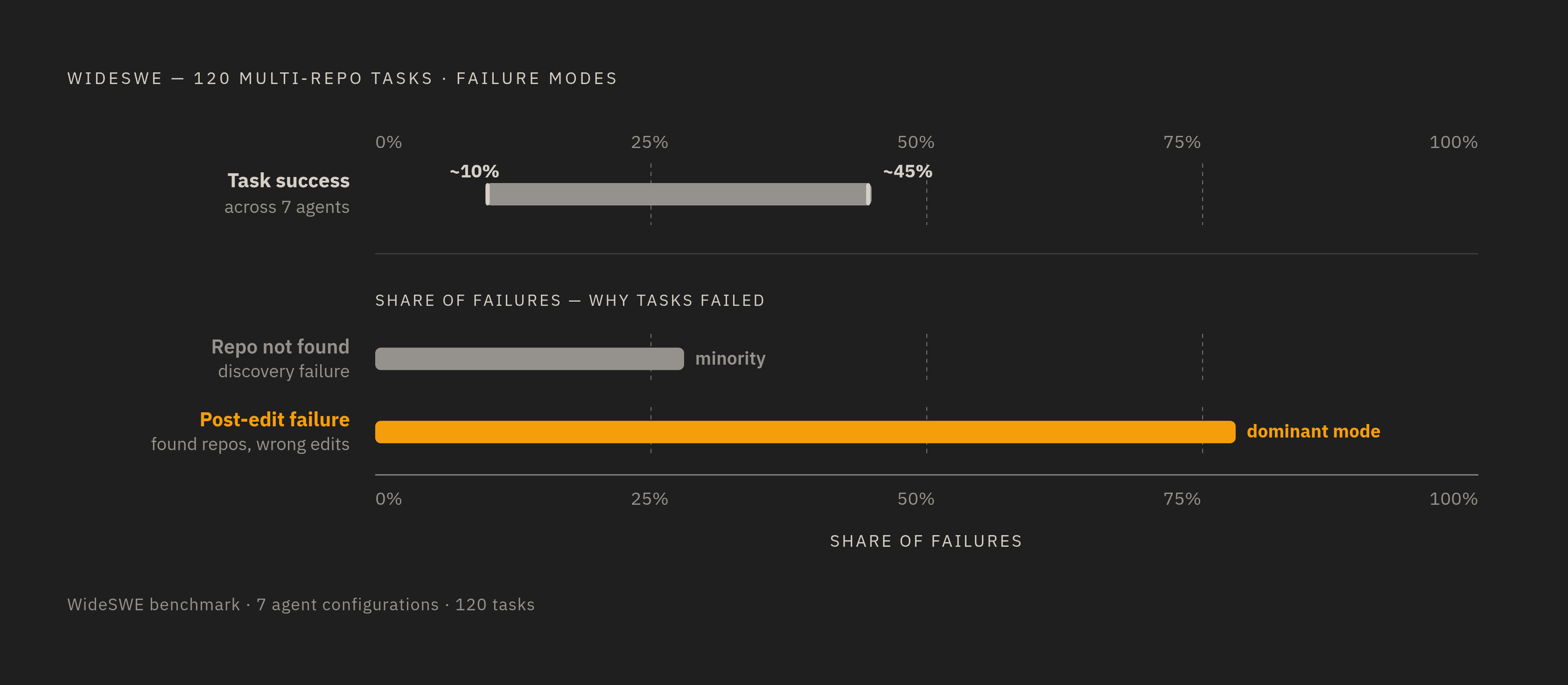
The WideSWE benchmark makes this distinction concrete across 120 real multi-repository tasks. Full task success ranged from roughly one-in-ten to fewer than half across seven agent configurations. Finding the repositories was not the dominant failure. More often, agents edited every target repository but still got the changes wrong, a pattern described as post-edit failure.
What "cross-repo context" actually means and what it must contain
Cross-repo context is runtime information about which repositories call the code being changed, which shared libraries and APIs it depends on, and how similar changes were handled before. It is not a whole-codebase dump. Qodo’s glossary identifies four types, namely repository relationships, contracts and schemas, PR history, and current Git state. Together, they describe dependencies, boundary-crossing interfaces, earlier decisions, and changes happening elsewhere right now.
Each type answers a different planning question. Repository relationships identify consumers, while contracts and schemas describe what those consumers expect. PR history supplies precedent, and current Git state reveals concurrent work touching the same endpoint. A one-line change to a shared protobuf Address message can affect multiple services, teams, and programming languages. Its local size says little about its organizational reach.
Timing is part of the definition too. Context available before writing shapes the plan, while cross-repo review after a PR opens checks the result. Neither substitutes for the other. Amir Rustamzadeh, Partner at Firestreak Ventures, noted on Qodo’s podcast that context management “hasn't fully solved” the problem because agents still get “tunnel vision”. The useful unit is a targeted answer to a question such as “which repositories depend on this library?
How teams operating agents at scale are already solving this by hand
Meta built a multi-stage pipeline with specialized agents to encode tribal knowledge previously held in engineers’ heads. The pipeline built a cross-repo dependency index and data flow maps. That changed the cost of discovery. “What depends on X?” became a single graph lookup consuming a fraction of the tokens previously spent exploring multiple files. The graph existed separately from the agent asking the question.
Neilos, a solo founder working across 15+ repositories, used a lighter coordination model. A manager agent held the cross-repo plan in working memory, a project registry mapped names to file paths, and writes were strictly isolated to one repository at a time. The coordination lived largely in the manager’s context. That approach worked at small scale, but as the team and the number of repositories grow, a single context window eventually runs out of room for the coordination model.
Mabl also built a dependency graph outside individual agent sessions. Its graph reduced context drift from a large share of agent failures to a small fraction. Across these examples, two teams built a durable, queryable dependency substrate, while the solo operation used session-level coordination. Teams are supplying persistent knowledge and access paths, and rebuilding those components independently duplicates the same class of platform work.
Why agents keep pulling engineers into queries even when a dependency graph exists
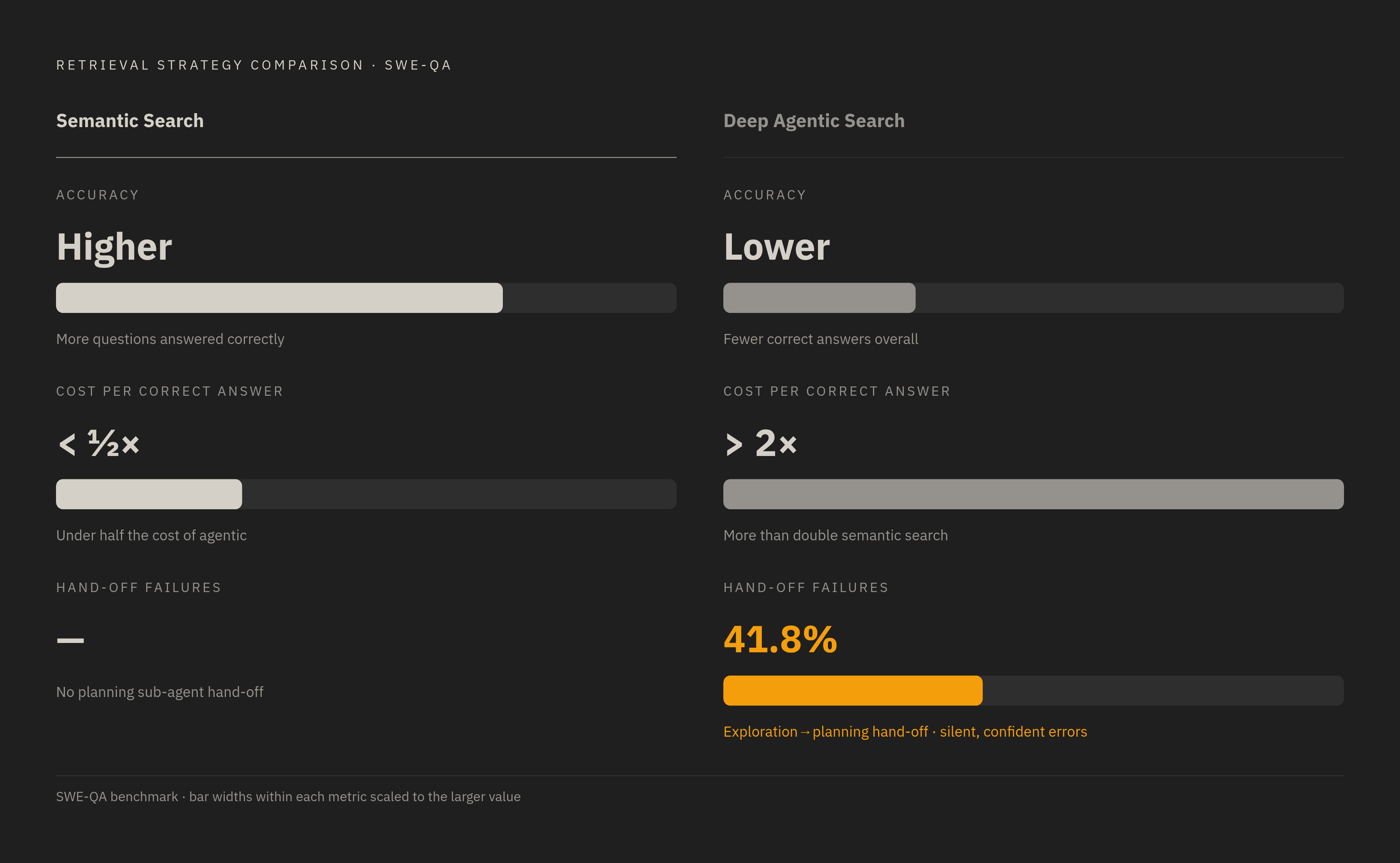
A dependency graph can exist without being retrieved effectively. The SWE-QA study compared semantic search from a pre-built vector index with deep agentic search, in which a planner delegates exploration to a sub-agent with an isolated context window. Semantic search got a much larger share of questions right, and each correct answer cost less than half as much. The retrieval strategy changed the result.
The two approaches trade different risks. Deep agentic search protects the planner from context pollution, the loss of accuracy as unrelated material accumulates, but introduces a hand-off between exploration and planning. The 2026 study attributed 41.8% of deep agentic search failures to that hand-off. Those failures usually led to smoothly written, confident wrong answers with no errors flagged.
Anthropic’s guidance makes the choice depend on the question. Agentic search works best when the agent already knows enough to decide where to look, but vague searches for relationships across huge codebases can use up the context before useful work begins. Static instructions do not resolve that tradeoff. Do Context Files Help Coding Agents? found no measurable correctness improvement from persistent context files across 288 evaluated runs with Claude Code and Codex. Its failures centered on implementation skill and pattern selection, narrowing the infrastructure claim to queryable, current data rather than documentation that merely orients the agent.
How MCP delivers cross-repo context to agents at enterprise scale
The Model Context Protocol gives agents a standard interface for querying structured external knowledge without loading it all upfront. Anthropic describes MCP servers that give Claude direct access to structured search for information the agent would struggle to find on its own. Discovery becomes a targeted tool call. An agent can send a dependency question to the cross-repo index instead of starting another open-ended search through files.
The resulting architecture separates knowledge from the session. A cross-repo index holds the dependency graph, schema registry, and PR history, while current Git state supplies the concurrent-change context defined earlier. An MCP server exposes that information to the agent at planning time. The protocol standardizes access. It does not by itself create a dependency graph or correct a poor retrieval strategy.
The July 2026 MCP specification introduced a stateless protocol core, removing the session-affinity and shared-session-store requirements that complicated horizontal scaling under earlier revisions. The 2026 roadmap also advances audit trails, OAuth 2.1, and configuration portability. Stateless transport addresses deployment complexity, while the roadmap describes work on enterprise controls.
MCP’s TypeScript and Python SDKs reached tens of millions of monthly downloads by March 2026. GitHub Copilot, Zed, Windsurf, and Cursor adopted it to provide agents with real-time project context, while Claude Code uses it heavily for development tools. The integration pattern is broadly available. Organizations can expose their cross-repo substrate through a standard transport rather than invent a separate connection for each agent environment.
Why self-hosted deployment is not optional for enterprises exposing full codebase context to agents
A cross-repo context layer concentrates proprietary code knowledge into one queryable surface. Where it is hosted therefore decides which infrastructure gets sensitive prompts, code relationships, and search data. The risk extends beyond raw source files. Embeddings encode proprietary semantics that can leak under inversion attack, and model providers may sit outside the customer’s compliance boundary.
Provider policies also differ by product tier. GitHub’s March 2026 privacy update stated that Copilot Free, Pro, and Pro+ interaction data, including inputs, outputs, code snippets, and context, would be used for model training by default from April 24, 2026, unless users opted out. Cursor’s Privacy Mode prevents code retention for training and is on by default for Enterprise teams, but requires opt-in for Free and Pro users. Without it, code goes to Cursor’s backend and may be used for model improvement.
MCP introduces its own security exposure. The nginx-ui MCP integration had a CVSS 9.8 authentication bypass vulnerability, CVE-2026-33032, while mcp-remote had a CVSS 9.6 remote code execution vulnerability, CVE-2025-6514. Hosting internally does not erase software flaws. The EU AI Act’s Article 50 transparency obligations applied from August 2, 2026, adding a further compliance consideration. For defense, finance, and healthcare buyers whose source code must never leave the network, self-hosted, VPC, or fully air-gapped deployment is a requirement.
How can cross-repo context help new engineers and non-engineers get answers faster?
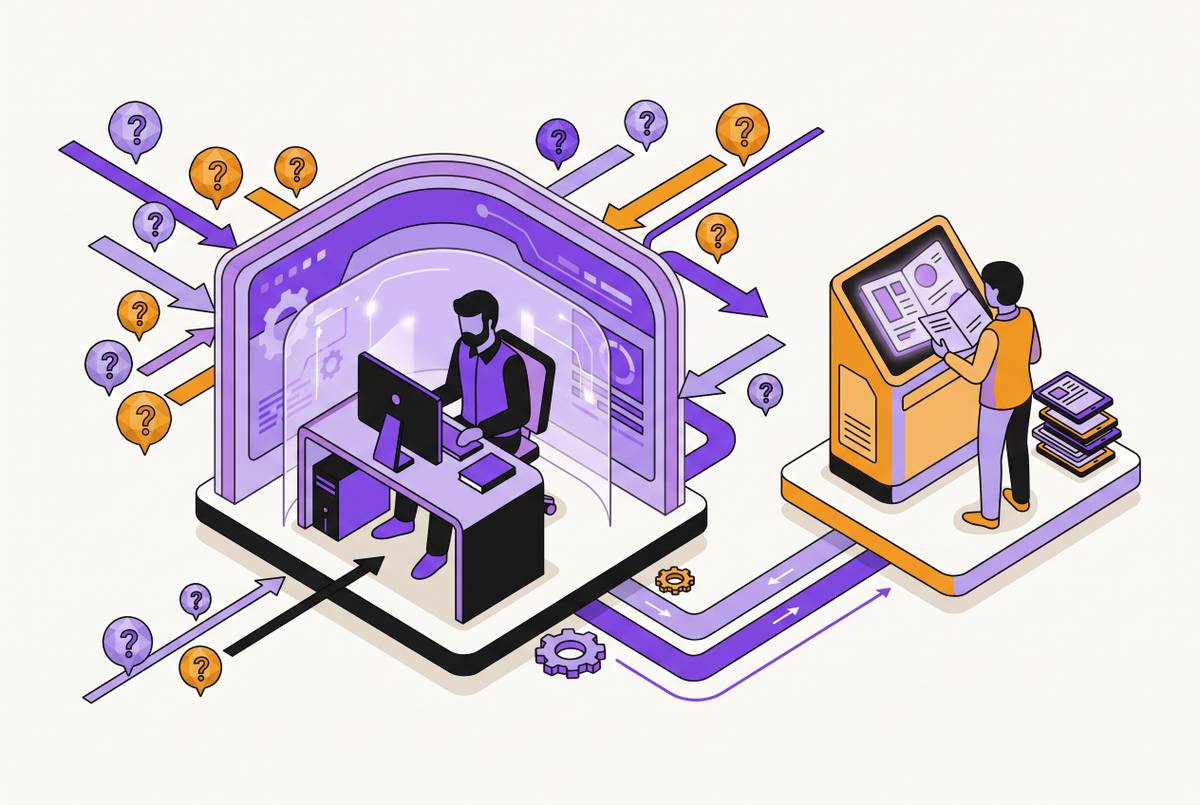
The same dependency and dataflow information that supports agents also serves PMs, support staff, security teams, and new hires. A privacy team asking “which third-party integrations receive PII?” needs relationships similar to those an agent needs when asking which services consume an API. Both questions cross repository boundaries. Giving these users direct answers from the codebase reduces the senior-engineer interrupt load that otherwise substitutes for missing search infrastructure.
For engineering onboarding, the distinction is between distributing setup and explaining the system. Claude Code shipped a built-in /team-onboarding command in version 2.1.101 in April 2026, generating a teammate ramp-up guide from local usage. It distributes setup by packaging the configured environment, custom commands, and conventions. It does not answer the separate question of which services depend on what.
Cross-repo search lowers the entry barrier to that second question by making relationships available without requiring a new hire to know where every answer lives. AI tools can help people read code from the bottom up, search documentation, and learn their way around syntax faster. Human engagement remains necessary from day one. Retrieved code alone cannot explain the architecture, why it was designed that way, which teams own what, or why past decisions were made. The onboarding benefit is earlier productive conversation at that higher level.
What breaks when the context layer is absent, measured against production evidence
The Cortex 2026 Engineering in the Age of AI Benchmark found that incidents per pull request and change failure rates rose as teams took up AI faster. That pattern fits with people making changes faster that are correct locally but miss their effects across systems. It does not establish the cause. Faster editing can coexist with declining reliability, extending the organizational risk beyond an agent taking too long.
Anthropic’s January 2026 randomized controlled trial adds a comprehension concern. Engineers who delegated code generation to AI scored far below those who used AI for conceptual questions on a follow-up assessment. Deployment mode affects what people learn. A cross-repo layer can supply missing relationships, but it should not be confused with the human reasoning needed to understand a change.
METR’s February 2026 follow-up found no statistically significant change in productivity from using AI. Point estimates suggested a speedup for returning developers, but wide confidence intervals crossed zero, and METR called the data unreliable because of selection effects. The productivity case remains conditional. These results caution against treating model access alone as a dependable productivity intervention.
The concrete infrastructure results are narrower and more useful. Mabl reduced context drift with its dependency graph, while Meta sharply reduced the token cost of a common planning question through graph lookup. Neither result required attributing the gain to a better model. The practical prescription is to build the dependency graph as a queryable substrate outside agent sessions, expose it through MCP, and deploy it inside the organization’s infrastructure when code is sensitive. That layer belongs in foundational platform infrastructure, where agents and people can obtain current context without making engineers reconstruct it for every query.