Building a Personal Codebase Map as a New Team Member
Help new engineers build their own mental map of unfamiliar systems.
New engineers get lost in a codebase for structural reasons, not because they read slowly or lack skill. The standard onboarding materials, a README, an architecture doc, a wiki page last touched two reorgs ago, describe a system that has since moved on, and the new hire has no reliable way to know which parts of that description still hold. Documentation debt accumulates the same way technical debt does: each change to the system that doesn't come with a matching update to the docs widens the gap between what's written and what's true. The real constraint on how fast a new hire gets productive is how many hours a senior engineer can spend walking them through the system, not how many hours the new hire is willing to spend reading. That's a scarce resource with a hard ceiling, and every team that onboards by scheduling walkthroughs is budgeting against it whether they've named it that way or not.
A large share of what a new hire needs to know was never written down anywhere. Conventions enforced by habit rather than tooling, invariants nobody bothered to comment because everyone on the original team already knew them, architectural decisions whose reasoning lived in a conversation three years ago and nowhere else: this is tribal knowledge, and it resists discovery by reading. A new hire can read every file in a service and still not know why it's structured the way it is, because the "why" was never encoded in the code itself. The only people who hold that context are the senior engineers who made the decisions, and the only way to extract it under the standard model is to ask them directly.
That dependency is expensive in a way that's easy to undercount. Each manual onboarding sequence pulls a senior engineer or platform team member away for 15 to 20 hours of walkthroughs, pairing sessions, and ad hoc Slack answers, and at the scale of a team hiring regularly, that adds up to something close to a full-time equivalent per quarter spent just getting new people oriented. Waiting on translation capacity that doesn't scale is a structural bottleneck, and the fix has to come from a practice the new hire can run independently.
What a personal codebase map is
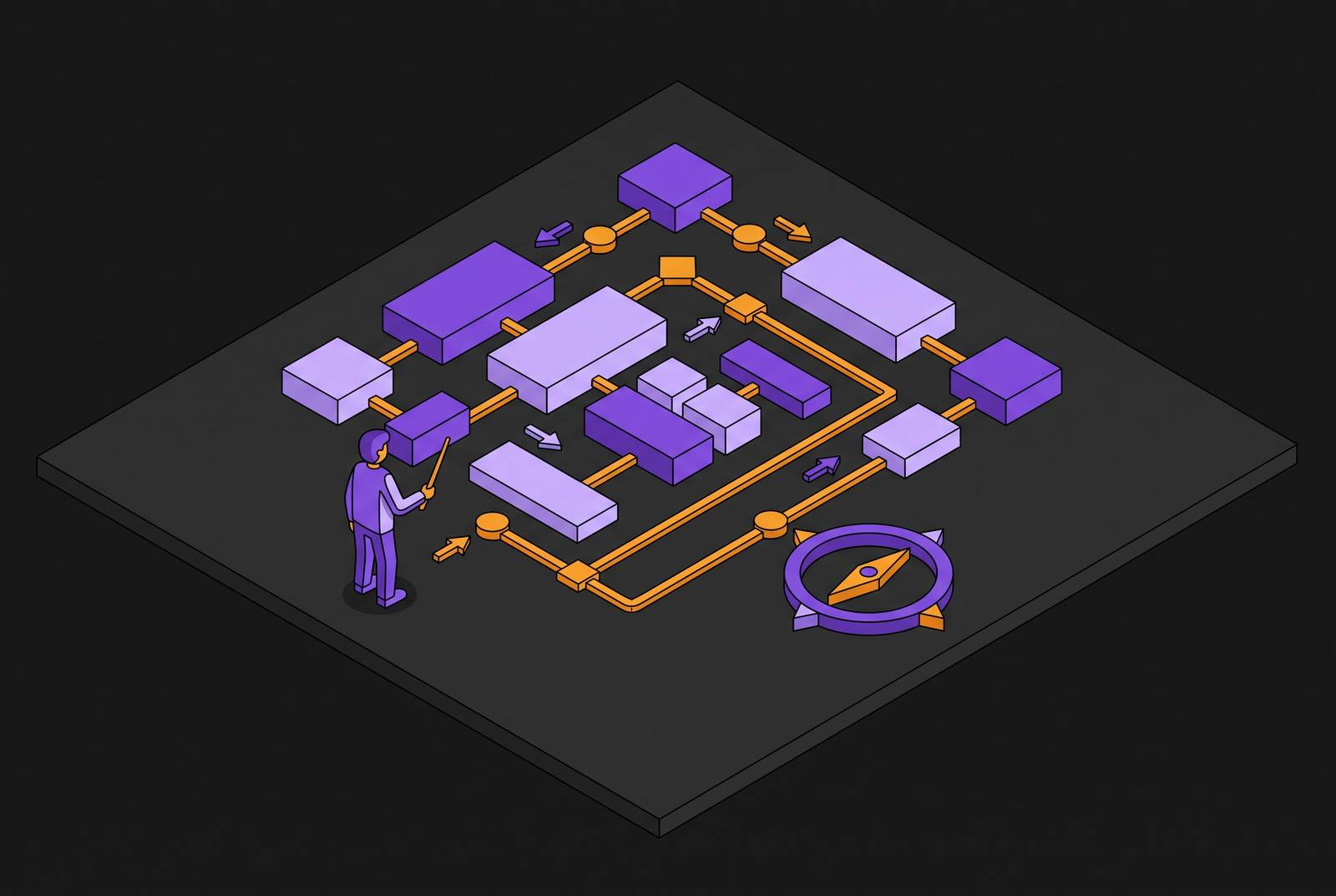
A personal codebase map is a self-maintained, layered mental model of a system that the new hire builds through their own navigation, not a copy of existing documentation and not something handed over by a senior engineer. It has at least three layers. The structural layer covers which services exist, how they're organized, and what owns what. The dependency layer covers how data and control flow between components: which services call which, where shared libraries live, what breaks when something upstream changes. The intent layer covers why a piece of the system looks the way it does, the constraints and trade-offs and past decisions that produced the current shape of the code.
The map is personal because it's built from the specific paths the new hire has traced themselves, not written as a reference for someone else's use. A personal map describes the system in terms of the exact questions this particular engineer has already answered through direct investigation. Two new hires on the same team will end up with maps that look different even if they converge on the same underlying facts.
The map is active because it comes from doing, not from reading: tracing a real request, running a real test, making a small change and watching what breaks. And the map will diverge from the team's official documentation over time, which is not a failure of the map. Divergence is information: it tells the new hire precisely where the official docs have gone stale, and that signal is often more useful than the docs themselves.
Getting oriented before tracing a single file
The first task is understanding the shape of the system, not its details: which services exist, who owns them, and how a change moves from a developer's machine to production. This comes before opening a single source file, because context read cold, without a structure to hang it on, doesn't stick.
Start with whatever structural documentation already exists, architecture diagrams, a software catalog, a README, but treat all of it as a hypothesis to verify. A well-maintained software catalog is the fastest entry point when one exists, because it surfaces service ownership, API docs, dependency maps, and runbooks from a single place instead of forcing the new hire to piece that picture together from six different tools. Teams without a software catalog often struggle to answer even the basic ownership questions, and a self-hosted code search layer can turn scattered repositories and documentation into something a new hire can query directly, which shortens this phase considerably.
Every team has its own internal glossary, "the monolith," "the data pipeline," "the legacy system," and these terms rarely mean what they sound like they mean to an outsider. Before drilling into any single service, locate the cross-cutting concerns that touch everything: where authentication lives, how the CI/CD pipeline is structured, how dev, staging, and production relate to one another. These are the seams the rest of the system is built around, and understanding them first makes every individual service easier to place.
On day one or two, run a local build and the test suite. Understanding the code isn't the goal at this stage. Write down what's observed immediately, in plain, unpolished language, before the mental model fades. These rough notes are the raw material the map gets built from later, and writing them down preserves details that would otherwise be lost once the mental model fades.
Tracing a request from entry point to data store to surface your first real map
The fastest way to build a cross-cutting mental model of a system is to follow one real request, an API call, a user action, a background job, from its entry point through every service it touches to where the result lands. This single exercise does more for comprehension than any amount of passive reading, because it forces contact with the structural, dependency, and intent layers all at once, in the order the system actually uses them.
Pick a request that touches several services rather than a trivial one that stays inside a single file. The goal here is breadth of exposure, not depth in any one component. At each hop along the trace, record four things: what component receives the request and which file handles it, what data is read or written and where it lives, what assumptions the code makes that aren't stated anywhere in comments, and what remains unclear. That last category matters as much as the first three. Open questions should be marked explicitly as open questions, not treated as gaps that need to be closed immediately, because trying to resolve everything in the first pass defeats the purpose of a fast trace.
Tests are a navigational aid as much as a verification tool. Where architecture decision records exist, reading the ADR for a service before tracing through it adds intent-layer context by explaining the reasoning behind a design, something a purely structural read would miss.
A first-PR task is a natural vehicle for all of this. A small, pre-selected bug fix or documentation correction that can be completed in under an hour introduces the team's Git flow and PR process while forcing the new hire to trace at least one path through the codebase end to end. It's a low-stakes way to run the entire exercise once, with a clear deliverable at the end of it.
Using AI agents as a navigation tool without outsourcing comprehension
Giving an AI coding agent direct access to the repository lets a new hire ask the kinds of questions that used to require interrupting a senior engineer. The condition that makes this work is that the new hire has to be driving the questions, not handing the agent the thinking itself.
The productive pattern looks like this: use the agent to find every file that touches a given feature, then read those files directly. Use the agent to explain what a function does, then verify that explanation against the tests. Use the agent to surface naming conventions, then apply them to the notes already going into the map. In each case, the agent accelerates the search, and the comprehension still happens in the new hire's own head.
The unproductive pattern, asking the agent to generate the map itself, carries a documented cost. An Anthropic randomized controlled trial found that AI-assisted junior engineers who delegated code generation scored lower on code comprehension than those who used AI for conceptual questions instead, which suggests that using AI to generate code reduces understanding while using it to navigate and ask questions supports it. Treating the agent as an instrument of investigation, with comprehension staying the new hire's own work, is the whole argument behind that distinction.
For teams with strict data-residency requirements, self-hosted or locally configurable tools are necessary, since agents that route code through an external server are not an option. Sourcebot, a self-hosted code intelligence platform, deploys as a single Docker container inside a company's own infrastructure, so code never leaves the customer's environment while still enabling the same kind of AI-assisted navigation. It's also usable by non-engineers, which matters beyond the immediate onboarding case: PMs and support staff who need answers from the codebase can query it directly instead of interrupting an engineer, which reduces the same interrupt load that senior engineers absorb during onboarding.
The data on daily AI use points in a consistent direction. The DX 2025 enterprise study showed a sharp drop in time-to-tenth-PR for teams using AI tools daily compared with teams using none. Junior engineers are using these tools the most, but senior engineers are getting the most time back from them, which is consistent with the idea that experience changes how productively a given tool gets used, not just how often.
Writing context files that encode what the agent cannot discover from code alone
Once a new hire has traced a system end to end and built their own map of it, they hold something genuinely rare: specific knowledge of which decisions the code itself doesn't explain. That position makes them well suited to write the context file a future new hire, or an AI agent working the same repository, would actually need.
AGENTS.md is the open-format Markdown file that has emerged as the standard vehicle for this. As of 2026, over 60,000 open-source projects use it. OpenAI's own Codex repository applies the format at monorepo scale, with AGENTS.md files spread across its directory tree, one per significant package or subdirectory, which stands as the clearest public example of what file-scoped context looks like in practice.
There's a real limit to how much should go into one of these files, and the evidence for that limit is specific. Gloaguen et al. at ETH Zurich found that LLM-generated context files reduce agent task success rates and increase inference cost substantially, while human-written files can improve success marginally but still raise inference cost. A human-written file should describe minimal requirements, since more content doesn't reliably translate into better agent performance and can make it worse.
Writing that first draft is also an act of knowledge capture in its own right. It takes the tribal knowledge a new hire extracted the hard way, through tracing, through asking, through getting things wrong, and turns it into something the next new hire can read on day one. That's how a team breaks the cycle where every new hire starts the same climb from zero.
Turning the map into a repeatable habit across the first 90 days
Building a codebase map is a practice that deepens over roughly 90 days, in step with the size and reach of the work the new hire is given, rather than a first-week event that ends once a new hire has read the architecture doc and shipped one PR.
Days one through five cover structural orientation: the first end-to-end request trace, and a first PR merged to confirm that the environment and the process both work. Month three is where a new hire operates with minimal hand-holding, contributes an improvement to the team's documentation or to AGENTS.md, and takes on a task that requires coordinating across services.
By the end of week two, a new hire should be asking targeted questions. The map makes that shift possible by converting vague confusion into specific, answerable questions that a senior engineer can answer in a sentence or two. Structured check-ins at 30, 60, and 90 days give the new hire a scheduled moment to surface whatever's still unclear, turning open items from the map into targeted asks instead of generalized confusion, and giving the team a concrete signal about where its own onboarding materials need to improve for the next person who comes through.
The real payoff of the map is the number of questions it eliminates before they ever reach a senior engineer's inbox. A new hire who has built their own map asks fewer and sharper questions, and that's precisely what lets senior engineers get their interrupted hours back, closing the loop on the structural cost named at the start: the bottleneck was never how fast the new hire could read, it was how much of the team's scarce translation capacity each onboarding consumed, and an active, independent map-building practice is what brings that cost down.