Measuring Onboarding Success for Non-Engineering Roles
Define success by whether non-engineers ask the codebase instead of interrupting engineers.

Time-to-first-commit, pull requests merged per week, ramp-up time to independent ticket completion: these are the numbers engineering organizations reach for when they want to know if a new hire is working out. All three assume the new hire's job is to write code. A product manager who needs to scope a feature, a support rep who needs to answer a customer's question about what the product actually does, or a new non-technical hire who needs to hold their own in a cross-functional planning meeting are not trying to produce commits. They are trying to understand a system well enough to act on it, and the standard vocabulary has no way to register that kind of progress. Without a measurement framework built for this group, an organization cannot actually tell whether a PM or support hire has become codebase-capable or is still quietly routing every real question through a senior engineer.
What non-engineering codebase roles need to accomplish during onboarding
Three roles make up most of the non-engineering population that regularly touches a codebase, and each has its own version of "productive." Product managers need to know what exists, what's feasible to build, and where a proposed change would land in the system, without waiting on an engineer to translate the answer for them. Support and customer success staff need to answer questions about product behavior by looking the answer up themselves rather than pulling an engineer away from their work. New hires in non-technical functions need just enough orientation to participate in planning conversations and scope requests accurately, instead of asking for things that don't map to how the system is actually built.
What ties these three together is independence: the ability to get a routine codebase answer without creating an interrupt for a senior engineer. Success there was never defined by whether they wrote code. It was defined by whether they could surface an answer on their own. At Intercom, more than 300 non-engineers became active weekly users of a coding agent, and the outcome that mattered was not how much code got produced but how consistently those employees kept coming back to the codebase on their own initiative.
Atlassian's engineering onboarding model offers a useful structural template, even though it was built for engineers: ship first code in week one, contribute to a major feature by day 30, lead a project by day 90. The same cadence works for non-engineering roles if "contribution" is redefined around understanding and judgment instead of code volume. The milestones can carry over. What has to change is what counts as evidence.
Codebase comprehension as the first measurable milestone
Comprehension for a non-engineer isn't the same thing as code literacy. Nobody expects a support rep to read a diff and understand its logic line by line. What matters is whether they know that the billing behavior customers keep asking about lives in a particular service, owned by a particular team, and that the right person to loop in if something breaks is identifiable without a Slack search.
This is observable in the questions a new hire asks. A new hire with a working mental model asks questions that already show awareness of where to look: "Is this handled in the billing service or the notifications service?" A new hire without one asks questions with no spatial sense of the system at all: "Where would I even find that?" Manager and peer check-ins, already a standard input in most onboarding frameworks, can catch this distinction by tracking the content of the questions asked during those check-ins.
A more structured version of the same test can run at the 30-day mark: present a real product scenario and ask the new hire to point to the relevant part of the codebase, the service involved, and the team that owns it. That exercise is the non-engineering analog to Atlassian's day-30 milestone of contributing to a major feature. It asks for correct orientation to a real product question without senior-engineer guidance, rather than a line of shipped code.
AI coding agents complicate this. Tools that give non-engineers natural-language search across every repository, surfacing who owns what and how a system evolved, shorten the distance to that first milestone by making the codebase navigable before the mental model has fully formed. With the right search tooling in place, orientation that used to take months can be compressed into weeks.
Question-asking independence as the metric engineering teams care about
The single most useful signal of successful non-engineering onboarding is where a new hire's questions go. If they're landing in a search tool, an agent, or documentation rather than in a senior engineer's direct messages, onboarding is working. At epilot, support staff started asking an agent product questions instead of tracking down the engineers who built the feature, and the agent became the fastest route to understanding how anything worked across five years of code history. That shift, from asking a person to asking the codebase directly, is the behavioral signal that matters more than any survey score.
Three things make this measurable rather than anecdotal. First, track the volume of codebase-related questions a new hire routes to engineering channels at the 30, 60, and 90-day marks. Second, use manager and buddy check-ins at each interval to ask a more specific question than "how's it going": did the new hire try to find the answer independently before escalating, and what tool did they reach for? Third, separate questions that genuinely require engineering judgment, such as architecture decisions or security tradeoffs, from questions that only require access to information that already exists in the codebase. The first category should keep going to engineers. The second category is what onboarding is supposed to redirect.
This is about making sure the interrupts that do happen are the ones that actually need a human judgment call, not the ones a search tool could have answered. Standard onboarding practice already calls for tracking new-hire progress through manager feedback and performance data at fixed intervals. Applying that same discipline specifically to where questions get routed turns a vague HR checkbox into something an engineering org can actually act on.
Reducing the engineering interrupt load as a team-level outcome to track
Question-routing data on one new hire is useful. Aggregated across a cohort, it becomes a team-level outcome that belongs in a quarterly engineering review, not just a performance file. Interrupt load, the time senior engineers spend translating the codebase for people who didn't write it, is a real cost and a measurable one, and it shouldn't be inferred indirectly from a satisfaction survey.
Three things matter: first and second are implied by context, and third, whether senior engineers' calendars are actually clearing of routine context-sharing meetings as the new cohort completes onboarding, since a drop in Slack questions that just gets replaced by more meetings isn't real progress.
The epilot numbers show what a bounded, well-measured investment looks like: 40 pull requests came out of 11 non-engineers over 60 days, produced through three one-hour onboarding sessions. The question a measurement framework has to answer before and after a program like that is what senior engineer time actually looked like on either side of it.
A drop in interrupts could mean non-engineers have gone quiet rather than become independent, disengaging instead of leveling up. Tracking output quality alongside interrupt volume shows whether a drop reflects independence or disengagement. Self-hosted code intelligence tools like Sourcebot matter here because they give non-engineers a direct, natural-language way to search the entire codebase themselves, which is the mechanism that lets the interrupt number fall. Without that kind of access, a PM or support rep has no path to an answer except asking an engineer, and no onboarding program can change that on its own.
Contribution quality when non-engineers submit code, measured without penalizing the role
When a non-engineer moves from reading the codebase to actually submitting changes to it, pull request throughput and defect rate are the wrong things to measure. What matters is organizational correctness: whether the change fits the codebase's conventions, respects who owns what, and lines up with where the architecture is actually headed, as opposed to something that compiles fine but doesn't belong where it landed.
The hardest version of this problem occurs when a designer submits a 10,000-line pull request that mixes copy tweaks and CSS changes in with a new feature, and the AI agent that helped build it mocked the backend without the designer realizing that mattered. The failure is that the designer had no way to know the scope of what they were submitting or what it implied for the rest of the system. That's a comprehension gap wearing the costume of a code review problem, and it should be measured as one.
Three metrics fit the role better than throughput or defect counts. Scope accuracy asks whether the pull request touched only the areas the non-engineer meant to change, or sprawled into adjacent services nobody asked for. All three should be checked at the 30 and 60-day marks.
The cost of getting this wrong runs in a specific direction: a non-engineer's pull request that needs heavy engineering rework consumes more senior engineer time than if that person had just asked a question instead of writing code. None of this is an argument for keeping non-engineers from contributing code. It's an argument for measuring the right thing so the onboarding process that gets them there can actually improve, instead of quietly treating every non-engineer PR as a smaller version of an engineer's PR and grading it on the wrong curve.
Putting the framework together: a 30-60-90 day measurement arc for non-engineering codebase roles
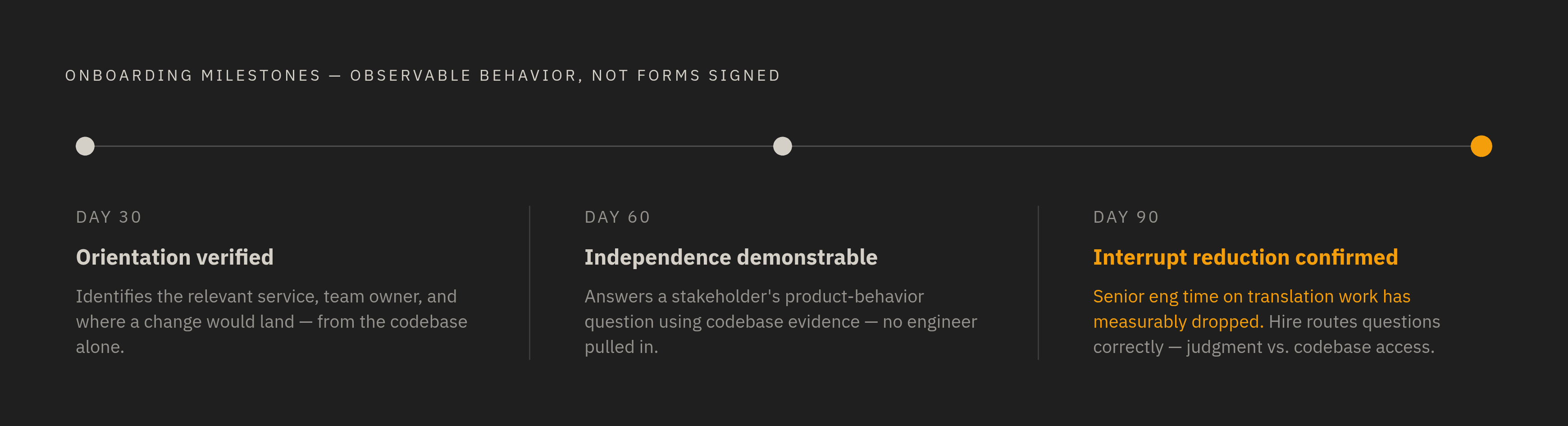
The pieces above assemble into a 30-60-90 day arc, adapted from the same structure engineering onboarding already uses, but built around comprehension and independence instead of commit volume.
By day 30, orientation should be verified. Have they gone through a structured codebase navigation exercise, or an equivalent check-in with their manager, where they demonstrated this directly?
By day 60, independence should be demonstrable. Can the new hire answer a customer or stakeholder's product-behavior question using evidence from the codebase itself, without pulling in an engineer to confirm it?
By day 90, interrupt reduction should be confirmed at the team level. Has the senior engineering time spent on translation work for this hire measurably dropped? Can they tell whether a question genuinely needs engineering judgment or just needs codebase access?
Skills-based onboarding already pushes organizations toward measuring demonstrated capability instead of training completion, and this arc follows that same logic: every checkpoint is tied to an observable behavior, not a module finished or a form signed. What counts as "fully productive" at day 90 for a PM who needs to scope features deeply is not what it looks like for a support agent who mainly needs fast, accurate product-behavior lookups, so the specific benchmarks at each checkpoint should be set with department heads before onboarding starts, not after. Treat this arc as a starting structure to adapt to how a given organization actually defines these roles, not a fixed script to follow line for line.
What makes this framework easier to run in practice
All of this depends on one condition many organizations don't yet have: non-engineers need a self-service way into the codebase that doesn't run through an engineer. If the only way to search the code is to ask an engineer to run a query, the interrupt-reduction number can't improve no matter how capable the new hire becomes, because the bottleneck was never the person, it was the access.
Three things tend to separate self-service access that actually works from access that exists on paper. Search needs to be natural-language and semantic, surfacing the relevant service, its owner, and its behavior for a plain-English question, rather than file-level grep that only works if you already know what you're looking for. It also needs to connect to the tools non-engineers already live in, like Jira, Linear, and Confluence, so engineers see codebase context next to the tickets and documents they're already working from instead of in a separate tab nobody opens.
Three conditions have to be in place for the measurement framework above to actually work. Engineering leadership needs a baseline interrupt volume measured before non-engineering onboarding begins; without one, there's nothing to compare the later numbers against. The scope of which roles count as "non-engineering codebase roles" needs to be defined up front, because applying these metrics to support tiers or marketing functions that never actually touch the codebase just produces noise. And the underlying context layer, meaning accurate ownership records, current architecture documentation, and a shared vocabulary between business and engineering terms, has to actually be complete, because an agent answering from incomplete context will give wrong answers regardless of how capable the non-engineer asking the question is.
That last point reframes what this whole framework is actually for. If the metrics in this piece stall out, the diagnosis isn't necessarily that the new hire failed to onboard. It might mean the codebase access wasn't really self-service, or that the context layer underneath it was missing pieces. The framework diagnoses the organization, pointing straight at whether the infrastructure for codebase comprehension was ever built.