Why New Engineers Spin Their Wheels in Large Codebases and How to Fix It
Senior engineers become the bottleneck in onboarding; structured tools dissolve it.

A new engineer's ramp time measures how much senior-engineer attention is available to translate code into context, and that attention is almost always the scarcest resource on the team. One senior engineer resigned after eight weeks of fielding onboarding questions for a cohort of new hires, a cost invisible on any recruiting budget line that shapes the entire 30 days that follow. The fix is a structural change to how codebase context gets delivered, and that is the argument this piece makes.
The 30-Day Ramp as a Measure of Senior-Engineer Availability
The standard onboarding story has a hidden character who appears in nearly every scene: the senior engineer explaining why the auth module looks the way it does, why the payments service has two competing implementations instead of one, why a migration runs differently on this product than it did on the last one. A new hire can read code as fast as anyone. What they cannot do is reconstruct years of decisions, trade-offs, and abandoned rewrites from the code alone, and that reconstruction work is where the real bottleneck sits. The 30-day ramp was never a measure of reading speed. It measures how much senior-engineer translation capacity a team can spare, and that capacity is the actual constraint on how fast anyone gets productive.
Three forces compound the pressure on that constraint. Documentation goes stale within months of being written, and once it diverges from the codebase it actively misleads. Tribal knowledge, the informal map of who knows what, does not scale with headcount unless the people holding that knowledge have hours free to transfer it, and the queue consumes those hours. AI-assisted coding has accelerated how fast codebases grow, widening the surface area a new hire has to understand faster than any one person could absorb it through reading alone. Each of these forces feeds the same queue: a line of new-hire questions waiting for senior attention, and the length of that line, not the ability of the person waiting in it, sets the pace of onboarding.
The Queue's Cost: Platform Team Overhead, Lost Output, and Compounding Ramp Time
The queue does not just delay the new hire. It draws down the platform team's capacity to build anything else. Every onboarding conversation, every walkthrough, every Slack thread answering "why does this lock exist" pulls a senior engineer away from their own roadmap for a real block of hours, and at any meaningful hiring volume those hours add up to something close to a full-time role nobody budgeted for: onboarding support, absorbed silently into the senior engineering headcount.
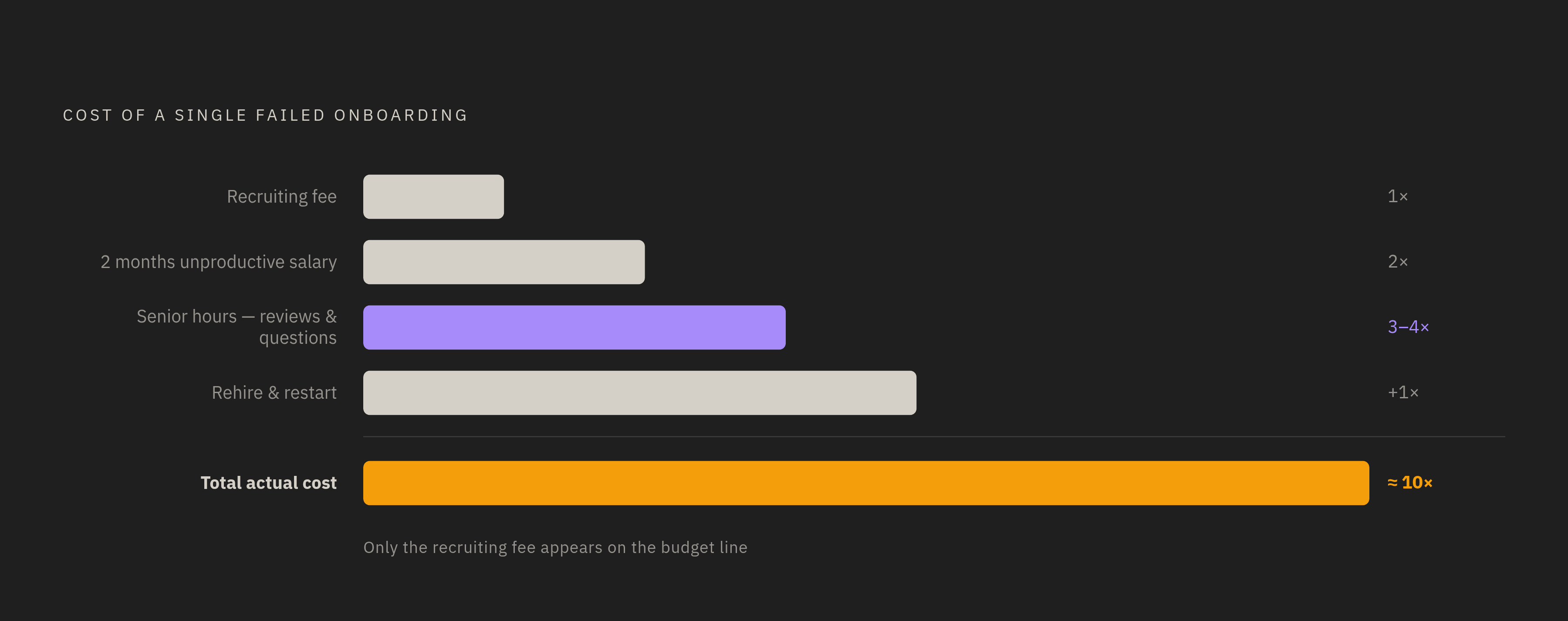
The cost compounds on the new hire's side as well. Without an answer, a new engineer either stops and waits, which extends the queue delay, or guesses and proceeds on a faulty assumption, which generates rework once the guess surfaces in code review. Neither path is faster than getting the right context the first time. In microservice-heavy or otherwise complex systems, the ramp period stretches well past what teams typically budget for, and the financial exposure runs far deeper than a salary line suggests: one documented case of a failed onboarding traced costs through the recruiting fee, two months of unproductive salary, the senior hours lost reviewing broken pull requests and answering confused questions, and then the cost of rehiring and starting over, landing at an order of magnitude beyond the recruiting fee alone.
Most engineering organizations still track onboarding success informally, through manager check-ins and gut feel rather than a measured benchmark, which lets this cost stay invisible on a dashboard even as it drains the team. A useful dividing line separates manual onboarding, built from Confluence pages, Slack messages, and senior-led walkthroughs, from automated self-service onboarding, where a new engineer provisions their own environment and starts shipping code without filing a ticket or waiting on the platform team. That gap between the two approaches is widening as self-service tooling matures, and it leaves manual-onboarding teams further behind every quarter they don't close it. "Time to 10th PR" offers engineering leaders a concrete proxy for closing that gap: a benchmark that AI-assisted onboarding has measurably shortened wherever teams have adopted it, and one worth tracking independent of any single tool decision.
Stale Docs and Tribal Knowledge as Structural Failures, Not Maintenance Lapses
Documentation and buddy systems are the two instincts every engineering team reaches for first, and both are reasonable responses to a real problem. Neither one addresses the actual cause of the delay, which is that most answers still require a human to produce them.
Static documentation decays the moment the codebase moves past it, and a new engineer following a stale page does not merely fail to benefit. They build a mental model on something false, and that false model generates confused pull requests and more senior interruptions than no documentation would have. For most engineers, onboarding material in practice is a three-year-old README and a stack of wiki pages nobody has touched since the original architect left the company. Following those pages does not shorten the ramp. It extends it: the errors embedded in outdated docs surface during code review instead of being caught before the PR is ever written, so the senior engineer pays the cost later and at higher interest.
Tribal knowledge fails for a related but distinct reason: it only scales with headcount if the people holding it have free hours to pass it on, and the queue is precisely what starves them of those hours. Lacking current documentation, a new hire has to build an informal map of who knows what, a kind of social detective work that burns both their own time and the time of whoever they end up pinging. Recording a one-time architecture walkthrough converts a single senior hour into a reusable asset, and that is worth doing. It does not answer the dynamic questions that come up weeks later, such as why a particular service still locks a resource the way it does, and whether that reasoning is even still true. The buddy system, the most common human investment teams make in onboarding, is honest about what it actually does: its job is not to answer every question but to make sure no question goes unanswered for more than a few hours. That is queue management, not knowledge transfer. The bottleneck has moved, not disappeared, and it only works as long as the buddy stays available.
How AI Coding Agents Change the Queue
The most common mistake teams make when adopting AI coding agents for onboarding is handing the licenses to senior engineers first and using the tool as a pairing accelerator during sessions with new hires. That deployment pattern feels productive because it speeds up the senior engineer's half of every conversation, but it preserves the exact dependency the team is trying to remove: the new hire still needs the senior engineer in the loop to get an answer. The structural fix only works if the new engineer holds the tool directly, as their primary way of investigating the codebase, rather than watching a senior engineer drive it on their behalf.
Placed correctly, in the new hire's own hands, an agent dissolves the bottleneck. Engineers who historically took months to become productive have closed multiple tickets in their first sprint by opening an agent against the repository directly, asking it to explain how a feature behaves, and asking it to locate every file touching their assigned area, bypassing the historical onboarding window of shadowing a senior engineer. Senior engineers on at least one such team reported that the portion of their week previously absorbed by onboarding interruptions shrank to a small fraction of what it had been. The gain here is that the agent removes senior-engineer translation capacity as the thing gating the whole process, not that new hires read code faster with an agent's help.
Two agent architectures are in active use for this pattern, and the choice between them depends on a team's existing tooling rather than any inherent advantage one holds over the other for onboarding specifically. IDE-augmented agents, with Cursor as the primary example, run inside the editor itself, in the same window an engineer already uses to read and edit code, so agent mode sits inline with the existing workflow. Delegation-loop agents, with Claude Code as the primary example, treat the repository as a workspace accessed through a command-line interface, with hooks, sub-agents, and the Model Context Protocol built in as first-class primitives. Anthropic ships a named "Understand new codebases" workflow with example prompts directly in Claude Code's own documentation, a sign that codebase orientation is treated as a first-class use case.
Why agents fail new hires when they lack full codebase context
An agent deployed correctly, in the new hire's own hands, still fails them if it cannot see the whole codebase. A confident answer built on an incomplete picture can do more damage than no answer, because the new hire has no way to tell the two apart.
Most agents default to operating on whatever is visible in the engineer's local environment: open files, recent edits, the immediate working directory, rather than the full repository graph spanning every service and every repo. For a new hire who does not yet know which files matter, that limited window creates a closed loop: pointing the agent at the right code requires already knowing enough about the system to find it, which is precisely the knowledge the new hire is trying to acquire. Even experienced engineers with the social capital to track down the right repo owner run into functionality buried in internal libraries they had no way to search for, because no tool lets them search across the whole codebase at once. A new hire without that social capital yet faces the same wall with none of the workarounds.
What closes that gap is a context layer: an index covering every repository in the organization, queryable by humans and agents alike, sitting underneath whatever agent the engineer happens to be using. Without it, an agent answers only from what it can see on one machine. With it, the same agent can trace how an authentication flow crosses five different services, locate every file touching a given feature regardless of which repo it lives in, and surface the reasoning behind a design decision that would otherwise require tracking down whoever made it. MCP has become the connector layer that makes this practical at scale: because it is a shared protocol, an agent running in Cursor can draw on the same context server as an agent running in Claude Code or any other compliant tool, which turns the context layer into a single investment serving the whole agent ecosystem rather than a separate integration job for every tool a team happens to use. The ecosystem of MCP servers already spans GitHub, Linear, Jira, Confluence, Sentry, Postgres, Slack, and Notion, making MCP the default way these systems connect.
Code intelligence platforms that give agents and new hires full codebase context
A tool built for this problem needs to do three things at once: index every repository the organization owns, expose that index to both humans through natural-language search and agents through MCP, and do all of it without sending proprietary source code outside the organization's own infrastructure. Teams evaluating options for this should weigh each candidate against that checklist directly, since missing any one of the three recreates part of the queue the tool is meant to solve.
Sourcebot is a self-hosted code understanding platform built specifically around that checklist. It deploys as a single Docker container inside an organization's own infrastructure, so code never leaves the customer's environment, which matters for any team unwilling to send proprietary source to a third-party service. It indexes every repository across the organization, giving new engineers and AI agents one interface to search, navigate, and understand the full codebase rather than just whatever files happen to be open in an editor at the time. Direct access to that index, whether through natural-language search or an agent querying the repository, converts tribal knowledge into something closer to a self-service answer: a new engineer can ask why the auth module looks the way it does and get a grounded response without waiting on the senior-engineer queue.
Sourcebot connects to Jira, Linear, Slack, and other tools through MCP-based connectors. The same surface that answers "where does authentication live" can also answer "what ticket drove this change," cutting down the social-detective work that otherwise eats into both the new hire's time and everyone else's. That combination also makes time-to-first-productive-PR a metric engineering leaders can actually track, since a self-hosted context layer shortens the queue by letting new hires serve themselves while simultaneously generating the usage data leadership needs to justify the investment. Teams keep bring-your-own-model flexibility, choosing their own LLM provider and keeping full control over where code gets sent during inference. A free tier indexes real repositories, so a team can test the approach against its own codebase before any purchase decision, and Sourcebot is positioned at less than half the price of legacy enterprise code search tools.
Static documentation cannot keep pace with a codebase that changes weekly, but a semantic code search layer keeps pace by construction, since it queries the current state of the code rather than a page someone wrote at launch and never touched again. OpenGrok, a self-hosted source code search and cross-reference engine, offers a longer-standing option in the same general space, indexing source code and building cross-reference tables that let engineers trace definitions and usages across a repository. The two tools solve overlapping but not identical problems, and the right choice depends on whether a team needs agent-facing MCP access alongside human search or primarily the latter. What both approaches share is the premise this entire argument rests on: the fix for a slow ramp is direct, on-demand access to the context a senior engineer used to have to supply by hand.