Scaling Engineering Onboarding Without Creating a Senior Developer Bottleneck
Make codebase searchable so new hires find answers independently.
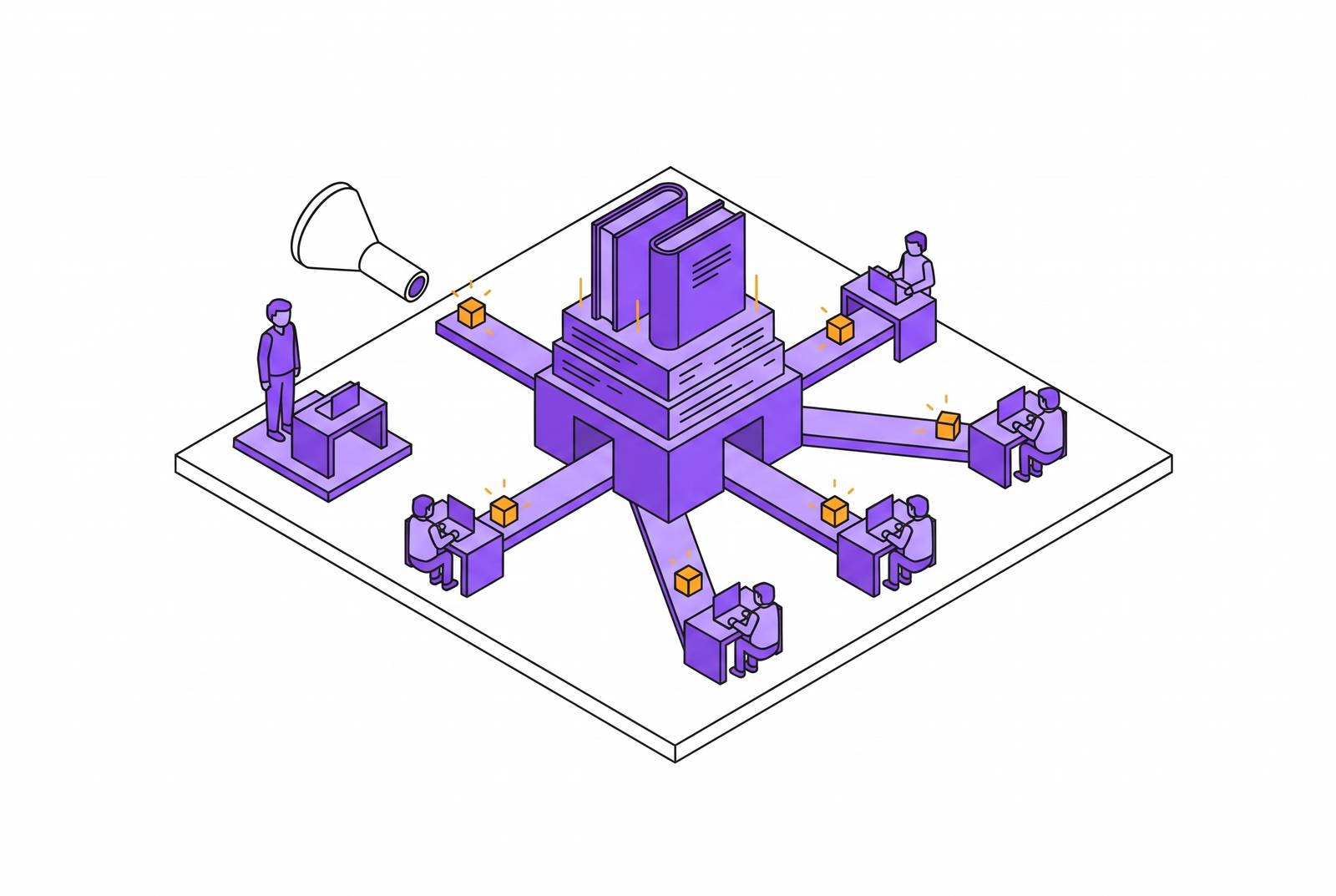
Engineering onboarding scales when new hires can answer codebase questions without waiting for senior developers. The bottleneck is primarily an information access failure. Direct, searchable code intelligence gives engineers and non-engineers a path to answers while reserving senior engineering time for architectural decisions, consequential reviews, and mentoring.
Why senior engineers have become the default answer to every onboarding question
A new engineer needs to find the logic behind an edge case, but does not know which repository contains it. The senior engineer who built the service knows where to look, so the question goes directly to that person. The next question follows the same route. Asking becomes the reliable way to navigate the system, even when the answer already exists in code. The dependency forms because one person can connect a question to its implementation and another cannot.
Senior engineers already divide their attention between code review, architectural decisions, and interviews, leaving less time to record what they know. Undocumented knowledge then makes the next hire more dependent on them. PMs, support staff, and people in compliance roles also struggle to find this information, often without the technical background to look into it on their own. The common cause is not a shortage of willingness to help, but information that is not findable without a person.
What the bottleneck actually costs when senior engineering time is the scarce input
Repetitive onboarding support consumes the same senior engineering capacity needed to review changes and unblock delivery. A new hire waits for context while the senior engineer has to fit another interruption around work that already needs their judgment. When several hires need that support, expanding the team places additional demands on the people responsible for keeping it productive.
Interview loops remove senior engineers from delivery at the moment the organization is trying to increase capacity. If onboarding also depends on when they have time, hiring someone does not ease the pressure right away. Delayed features, missed enterprise launch dates, and deferred security compliance milestones are the downstream risks when engineering capacity remains constrained.
“Time to 10th PR” provides a benchmark for developer ramp-up beyond the first contribution. AI tools can improve that progression when they let new hires ask codebase questions without interrupting peers. The relevant distinction is how the answer is obtained, rather than whether the team has added another onboarding step. Independent information retrieval makes this portion of the capacity loss preventable.
Why documentation alone does not close the information gap
The code continues to change after that description is written, and maintaining the account requires time from people who understand the changes. A README that got setup right six months ago may no longer describe the system as it is now. Better documentation discipline can narrow that gap, but making overextended senior engineers responsible for closing it preserves the same dependency in another form.
The questions that trigger interruptions also exceed what static write-ups can reasonably cover. A new hire wants to know where an edge case is handled, which service calls another, or what changed in a module last quarter. A wiki cannot substitute for investigating the implementation, and some knowledge was never written down because the original builders had no need to explain it to themselves. Documentation still helps people find what was intended and what was decided. For current behavior, however, the codebase itself is the best documentation when it can be searched and navigated directly.
How can new engineers get up to speed on a large, unfamiliar codebase faster?
New engineers orient themselves faster when they can move from a question to the relevant implementation without first finding its human owner. Cross-repository search lets them locate a function even when they do not know which repository contains it. Dependency mapping then helps them follow the relationships beyond that function. Cross-references between code and documentation link the implementation to decisions that were written down, while historical context helps explain how it changed.
Instead of asking a senior engineer to locate the code and explain every connection, a new hire can trace the dependency and bring a focused question about the decision behind it. During that investigation, new hires can find architectural decision records, design patterns, and guardrails that were written down but buried in a wiki. Search can expose the evidence needed to distinguish a navigation problem from a genuine judgment call.
AI agents can accelerate this work when they receive the same context. Claude Code can pull a failing commit, run a test suite, and suggest a patch. For onboarding, those capabilities become useful when the agent can inspect the broader codebase rather than relying only on the files the new hire already knows to open.
Why AI coding agents in enterprise onboarding require full-codebase context, not just local file access
An agent restricted to local files inherits the new hire’s incomplete view of the system. The engineer does not yet know which files are relevant, so the agent may receive a narrow and unrepresentative slice. More fluent answers do not repair missing evidence. A proposed change can pass local tests while violating a pattern elsewhere, or duplicate a utility in a repository the agent cannot see. Senior engineers then absorb the work of correcting errors introduced by incomplete context.
Full-codebase context fills in that missing view so the agent can see relationships across repositories and the team’s conventions. Model Context Protocol, introduced by Anthropic in late 2024, provides a standardized way for agents in different environments to connect to the same context services. One MCP server for an internal service catalog can work with more than one agent. Access rules live in the server rather than being scattered across prompts, giving the team a shared place to govern that connection.
The infrastructure investment is therefore broader than choosing a coding model. Teams need recorded decisions, patterns, and guardrails that agents can retrieve on each run. A more capable model still cannot use information it has not received. As more engineers and agents join, a shared context layer lets them use what the team already knows without someone having to explain it again for each tool and user.
The privacy and control requirements that shape how enterprise teams deploy code intelligence
Enterprise access decisions must account for where code goes after it becomes searchable. Cloud-hosted AI coding tools can send prompts and the code context around them to a model provider, raising concerns about exposing proprietary code and regulated data. Healthcare teams must also think through whether protected health information could end up in a coding prompt. Visibility and privacy are therefore part of the same infrastructure decision, rather than separate approvals applied to an otherwise finished deployment.
Self-hosting requires a precise definition of the boundary. Keeping builds and repository checkouts on premises does not keep code inside the organization if inference still runs in a vendor’s cloud. Engineering leaders need to distinguish where the index runs, where the agent runs, and where the model receives context. Bring-your-own-model flexibility gives teams control over their provider and where code is sent. A self-hosted intelligence layer meets the no-code-egress requirement only if inference also keeps code inside that boundary.
A single Docker container inside the organization’s infrastructure can provide the deployment shape for this model. MCP connectors can extend the context to Jira, Linear, and Confluence without requiring the code itself to leave the network. Proper access controls remain essential. An agent running locally is not automatically safer, because it may reach sensitive files, terminal commands, and credentials outside the visibility of traditional network security tools.
Extending codebase visibility to non-engineers without increasing engineering support load
A PM scoping a feature may need to know what an existing service does or which behavior a feature flag controls. A support engineer answering a customer may need to locate the logic behind an edge case. Neither request necessarily calls for an architectural decision. Yet both route through engineering when the requester has no direct way to inspect the implementation. An answer that takes several minutes to give can still take days to obtain because access to the person is the constraint.
Natural-language queries provide a path through that constraint without requiring the requester to learn to read code. The PM can ask about the flag, while support can ask about the behavior relevant to the customer’s question. Compliance staff can also look into how code behaves to check a compliance claim, while still using judgment to assess what they find. People can get answers to routine questions without an engineer having to explain what the implementation does.
The same access helps people who join technical teams from non-technical backgrounds. They can learn their way around on their own without asking engineering colleagues to walk them through it again and again. With self-service information retrieval, people in these roles can spare the senior team the work of answering the same questions. It expands the benefit of the onboarding investment beyond the engineers whose arrival first exposed the bottleneck.
What a code intelligence layer looks like in practice for a team scaling from 20 to 60 engineers
For a team scaling from 20 to 60 engineers, the operational model is a shared intelligence layer connected to existing repositories and project tools. A self-hosted platform deployed as a single Docker container indexes the repositories and connects to Jira, Linear, and Confluence through MCP-based connectors. Centralized access controls determine which repositories each role can retrieve. These permissions are auditable rather than dispersed across individual tool configurations. Full-codebase context means the full context a user is authorized to access.
On day one, a new engineer can search by function, dependency, or concept before their first standup. The same context is available through MCP to an agent in the editor or terminal, so investigation is not confined to a local checkout. During the first weeks, questions about implementation can be answered from the index and linked records. Senior involvement shifts toward reviewing the interpretation and proposed changes.
As those hires contribute, their PRs, ADRs, and code changes become searchable context for subsequent hires. The organization builds on recorded work instead of repeating the same orientation through a senior engineer. Ramp-up can be assessed through Time to 10th PR, with attention to whether new hires can resolve codebase questions independently. The investment is shared engineering infrastructure. Its value comes from supporting successive hires and their agents through the same governed source of context.
Where the senior engineer bottleneck persists even after codebase visibility is solved
Architectural tradeoffs, security review of AI-generated code, production incident diagnosis, and decisions involving context outside the codebase all require more than search. Full-codebase visibility gives a new engineer better evidence for these discussions. It does not make every proposed change correct, and a capable agent does not remove the need for senior review of consequential work. Knowing whether generated code is right remains distinct from being able to generate it.
Mentoring is still needed, with more focus on where judgment matters. A senior engineer can discuss why a proposed approach is appropriate instead of spending the session locating functions and explaining repository boundaries. The practical test is whether the question asks for information or judgment. If it can be answered by searching the codebase, self-service access is the appropriate route. If it asks whether an answer is right, whether a tradeoff is acceptable, or what should happen next, senior involvement earns its cost.
The desired outcome is a reallocation of senior time. Senior engineers can spend the time they once spent on repeated explanations on architecture, technical direction, and review, giving them more room to guide the growing team and the agents writing code with it.