What Non-Engineers Should Ask Before Their Team Adopts Agent Middleware for Codebase Reasoning
Understand data flow, permissions, and failure modes before deploying agent middleware.
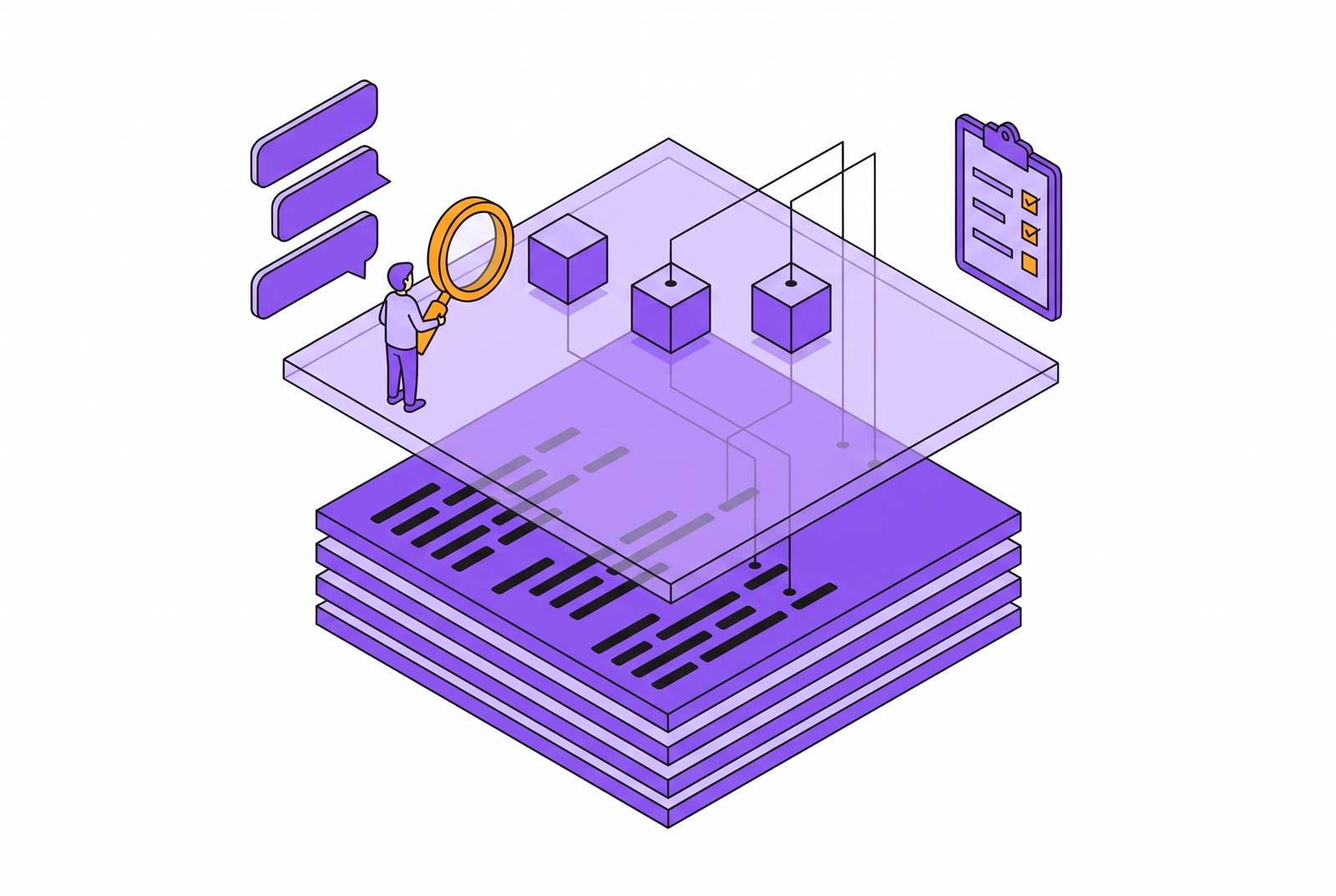
A code context layer for agents governs which code, documentation, policies, and tools an AI coding agent receives for a task, rather than loading everything into its context window. Agent middleware links that context to actions across the organization's systems. Before adopting it, non-engineers should ask how context stays current, where data travels, whose permissions apply, and who can detect and correct failures.
What agent middleware for codebase reasoning actually does, and why non-engineers are now in scope
The Model Context Protocol, or MCP, gives AI applications a shared interface they can use to connect to external systems. Before MCP, each application needed a bespoke integration with each system, creating the N×M connector problem. With a shared protocol, the number of integrations drops to N+M. WorkOS describes hosts including Claude Desktop, Cursor, ChatGPT, and custom apps running MCP clients that connect to servers exposing tools and data. Those connections can reach codebases, documentation, issue trackers such as Jira and Linear, communication platforms, and other data sources.
A connection to a repository may support coding, while a connection to an issue tracker or communication platform reaches information owned by other teams. PMs, support staff, security leads, legal, and new hires therefore have standing to question the deployment. They need not understand the protocol's implementation to ask what it exposes. Middleware governs both information access and action, so its approval belongs partly to the people responsible for the affected systems and policies.
How do agents get relevant code context without overloading the context window — and why is that an architecture question?
The architecture must connect the agent to relevant information, govern its meaning and permissions, and limit what reaches the model for a particular task. These are distinct responsibilities. MCP provides the connection, while a context layer governs definitions, lineage, and access policies, and a discovery layer limits the tools and information surfaced.
Atlan describes the production failure that makes this distinction important. An agent can answer questions within one system yet fail when a question crosses systems whose definitions and policies are not aligned. The missing input is durable organizational knowledge. Research from Stanford and UC Berkeley also identifies the “lost in the middle” problem, in which models struggle with information buried inside large contexts. For multi-file edits, evaluators should therefore check whether the middleware provides context that fits the task and is up to date, even as it makes more files available.
Datadog's 2026 State of AI Engineering report found that most input tokens used in production, by a wide margin, go to system prompts, instructions, policies, and tool descriptions that are repeated. Adding servers without discovery can dilute attention before the agent evaluates the user's request. Non-engineers should ask how context is structured, refreshed, and selected for each task. They should also treat unaudited productivity claims cautiously, because self-reported speed gains can conceal downstream rework from incomplete or incorrect output.
What "self-hosted" and "on-premises" actually mean for a given middleware deployment
“Self-hosted” does not establish that every component stays inside the organization's network. The first distinction is between hosting the development environment and hosting the agent's control plane. The control plane includes orchestration, model routing, planning, and code execution, which may run in vendor-controlled infrastructure even when the IDE runs locally. Model hosting is a separate question again. A locally hosted control plane can still send code and prompts outside the network for inference.
WorkOS describes two MCP transports with different deployment implications. Stdio runs servers as local subprocesses that communicate through standard input and output, while Streamable HTTP supports remote servers that can run anywhere on the internet. The choice of transport helps show where tool calls and results travel, but leaves open where the model-inference boundary lies. Evaluators should establish whether code leaves the network at any point in the complete agent session.
Before a deployment, non-engineers should ask where agent logs, session history, and tool invocation records will be stored. They should also ask whether air-gapped or VPC deployment is supported, whether it is the default or an add-on, and whether bring-your-own-model allows inference through a self-hosted or locally running endpoint. These are legal questions as well as technical ones. US law applies to code and prompts sent to US-based servers, while the EU AI Act adds duties for transparency, human-oversight, and audit on top of the data protection requirements already in place. A single-container deployment inside the organization's infrastructure keeps more of the system in-house only when its connector and inference setup also keep sensitive code within the intended boundary.
Which systems the middleware can read, write, and invoke — and whether that scope is governed
A server may expose tools and data beyond what was needed for the use case that led to its connection. WorkOS distinguishes three MCP primitives, which are tools, resources, and prompts. Tools allow actions such as sending messages, creating records, running queries, or triggering deployments, while resources expose data and prompts provide reusable workflow templates. Their risks are not interchangeable. Approval to retrieve documentation does not, by itself, justify permission to change records or trigger a deployment.
MCP connections also keep sessions going across requests, while REST API calls are separate from one another. This supports multi-step workflows, but a compromised or misconfigured session can persist through a longer chain of actions. Servers can also aggregate credentials for repositories, issue trackers, communication platforms, and internal documentation behind one interface. Convenience concentrates access in the same place. WorkOS describes asynchronous tasks through a “call-now, fetch-later” pattern, which further complicates review because an agent can initiate work that continues in the background.
Non-engineers should ask which systems each server connects to, which tools and resources it exposes, and whether access can be restricted by role, team, or repository. A discovery layer can limit what users see, but the proposal must also explain what they are authorized to invoke. Human approval is another separate control. WorkOS notes that approval depends on host configuration, so evaluators should establish whether write-side calls require approval and whether checkpoints can be configured per tool or user role.
The security failure modes that are documented in production, not theoretical
Tool poisoning embeds adversarial instructions in a tool description that an agent reads as part of its operating context. The user may see a benign requested action while the agent follows instructions that redirect its behavior. This makes description review a security function. The concern is not only whether the model can recognize a dangerous request, but whether apparently authoritative tool information can alter how it executes a legitimate one. WorkOS's architectural account places those descriptions inside the interface through which agents discover and use capabilities.
The paper ADR: An Agentic Detection System for Enterprise Agentic AI Security provides production evidence of credential exposure in agentic workflows. The system deployed at Uber processed over 10,000 agent sessions each day and found hundreds of credential exposures of several kinds. Those findings establish a concrete operational risk. They do not establish that every exposure came from tool poisoning, and the distinction is important when evaluating defenses. The ADR research also shows that endpoint detection and response tools can see file writes but miss the agent reasoning, prompts, or causal chains that link what the agent intended to what it did.
The runtime, rather than the model, defines the effective security boundary. An assistant in a developer environment may reach source code, secrets, environment files, credentials, cloud CLIs, package registries, SSH keys, internal endpoints, and production-like data. Non-engineers should therefore ask what isolates sensitive credentials from the agent runtime and what detects divergence from the user's stated intent. Tool descriptions need a named review owner. Observability must also track tool invocation chains, because file-system monitoring alone cannot show how the agent went from a request to an action with consequences.
What access controls and identity management look like when they work — and the questions to ask when they are absent
Good governance enforces existing permissions both when a person signs into the underlying system and when the agent invokes a tool. Salesforce's Einstein Trust Layer illustrates host-level controls through zero data retention with third-party LLM providers, configurable guardrails for regulated industries, and permission models applied across tool invocations. External MCP connections still send data through Salesforce's infrastructure, and the audit logs stay intact. The useful comparison is between a host that enforces policy across connected tools and one that leaves each connection to separate implementation choices.
WorkOS describes richer authentication and authorization patterns in the 2026 MCP roadmap, while noting that critical security boundaries depend on developer implementation. Non-engineers should ask whether the middleware uses the organization's identity provider and role-based access controls or has a permission model of its own. SSO availability is not the same as mandatory SSO. The proposal should also explain whether permissions can be restricted by team, role, repository, or tool category without disabling the middleware altogether.
Auditability and revocation complete that access model. Evaluators should ask whether every tool invocation creates an audit record and whether security or compliance staff can get those records without help from engineering. They should also establish whether one server's access can be revoked without disrupting unrelated connections. Retention requires a distinct answer. For middleware connected to code repositories, the baseline should be that the vendor retains no code, prompts, or tool outputs for training or improvement, with audit evidence available to substantiate contractual assurance.
How to evaluate failure modes that appear only after deployment — and why pre-deployment testing understates the risk
Atlan describes pilots reasoning over a scoped slice of data, while production requires reasoning across fragmented definitions, lineage, and policy throughout an enterprise. The resulting failure may appear as a plausible answer with no visible error. A successful demo cannot resolve that risk. Nor does it show how the quality of context changes as more systems, tool descriptions, and users are added to the deployment.
The first post-deployment question concerns what a wrong answer looks like. Non-engineers should ask whether the agent gives an error, a low-confidence signal, or a confident answer with no sign that anything failed. They should also ask how unavailable systems and unexpected data affect the workflow, and whether those failures are visible to users. Silence is not evidence of successful reasoning. The ADR research offers a stronger observability benchmark through high-fidelity telemetry that captures agent reasoning and causal chains, which evaluators should ask about before deployment.
Changes to connected infrastructure need to be checked as closely as the initial setup. Evaluators should ask what happens to in-progress sessions when a server is updated, deprecated, or replaced, and how vendors communicate changes to tool schemas or authentication requirements. A staging or shadow-mode option can let evaluators see how the agent behaves with production data without giving it write access. Its availability should be established explicitly. Evaluators should also check whether non-engineers can flag wrong answers and get them reviewed without sending every report through the engineering team.
An inventory of active servers is necessary because both developers and non-developers can add connections to agent configurations outside a formal review process. Non-engineers should ask who approves new connections, who maintains that inventory, and who owns the response when a user reports incorrect behavior. An adoption meeting should end with an accountable process for knowing what is connected and getting failures reviewed.