How Senior Engineers Actually Teach Monorepo Navigation to New Hires
Senior engineers teach monorepos through context transfer, not documentation.

A monorepo concentrates every onboarding difficulty into a single, undifferentiated space. New engineers don't fail because they lack material to read. They fail because the context that would let them navigate safely lives in senior engineers' heads, not in any document. This is a context-transfer problem, and solving it requires understanding what that context consists of.
The core onboarding failure in a monorepo is not missing documentation but missing context. A new hire cannot navigate safely without knowing system shape, ownership boundaries, historical decisions, and blast radius, and none of those live in a README. Teams respond to slow ramps by writing more onboarding docs, which is precisely backwards. The problem was never documentation volume. It was addressability.
A monorepo collapses what would have been separate, bounded repositories into one space. In a polyrepo, the repository boundary itself performs a kind of orientation work: it tells an engineer where one domain ends and another begins. A monorepo removes that boundary. The new hire confronts a single tree containing everything.
The result is that the new hire's first instinct, clone the repository, search for the relevant file, make a change, produces unsafe commits. A shared library touched by that change might break services the new hire has never heard of. The commit is correct locally and dangerous systemically, because correctness in a monorepo is a property of the whole, not of the file.
A doc is a snapshot of a moving system and starts drifting the day it is merged. The monorepo moves faster than any human documentation process can keep up with. By the time a README describes the current shape of the checkout service, two teams have reorganized and a library has been extracted. The documentation problem in a monorepo is not that docs are hard to write. It is that they decay faster than they can be maintained, and the new hire cannot tell which parts are still true.
The Four Kinds of Invisible Context Senior Engineers Carry
Effective monorepo onboarding requires transferring four specific types of context, each of which fails differently when it is absent. These are not interchangeable forms of knowledge. Each has its own loss mode, and a new hire missing any one of them will stumble in a characteristic way.
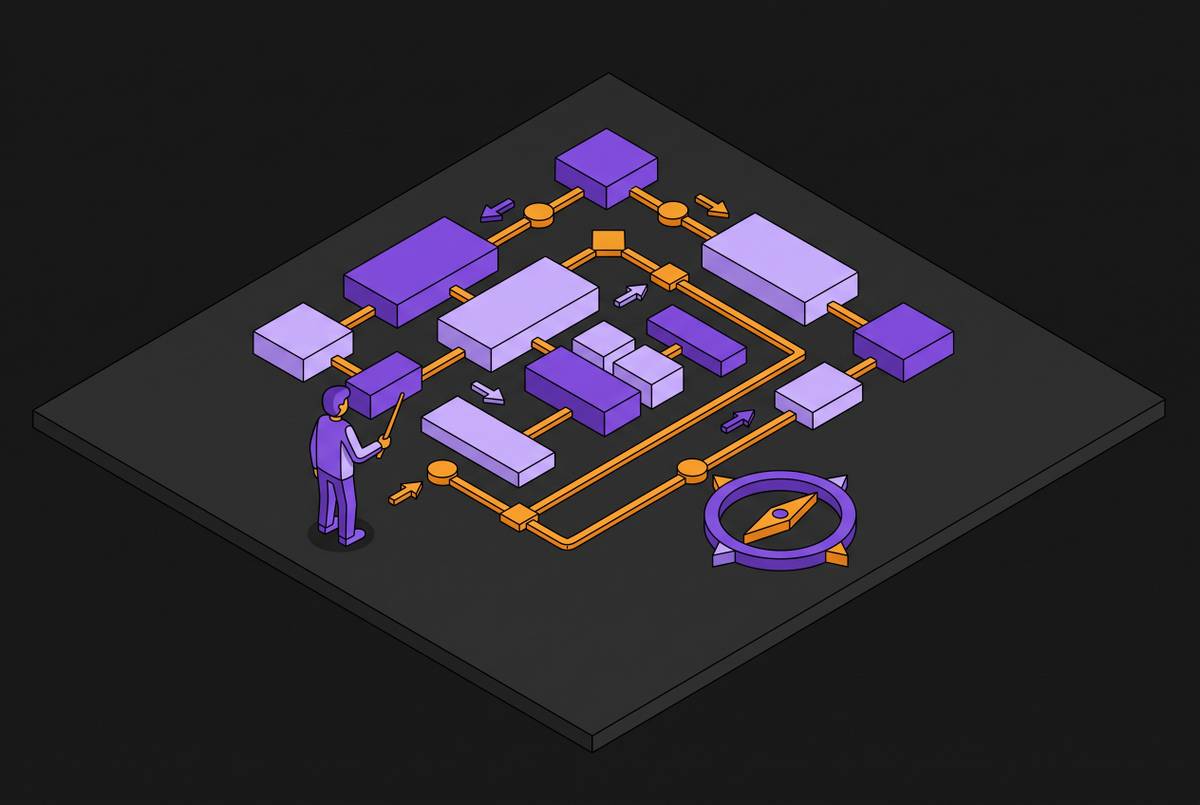
System shape is the overall architecture: product boundaries, where control enters the system, the main modules and layers, and which areas are risky. Senior engineers carry a map of the system that they built up over months or years of reading git history, attending design reviews, and getting burned by cross-service breakage. That map is the most valuable thing they possess, and it is almost never written down.
Ownership topology is who owns what and why: the social and organizational structure mapped onto the codebase. Ownership comes from git history. The real navigation skill being taught is ownership topology, not syntax.
Historical decisions are the reasoning behind code whose authors are gone: the constraints, trade-offs, and rejected alternatives that are invisible in the code itself. A new hire who cannot see the reason either asks around or cleans it up and reintroduces the original bug in week one. Architecture Decision Records are the structural answer, but most repos have few or none, and the ones that exist are often not linked to the code they govern.
Blast radius is what a change could break, which tests to run, and who to alert before merging. Knowing blast radius and owners before opening a pull request turns a fast first commit into a safe one. A new hire can read the code of the shared library and understand it completely without ever learning that fourteen services depend on it.
The Buddy System: What the Highest-Leverage Human Intervention Actually Looks Like
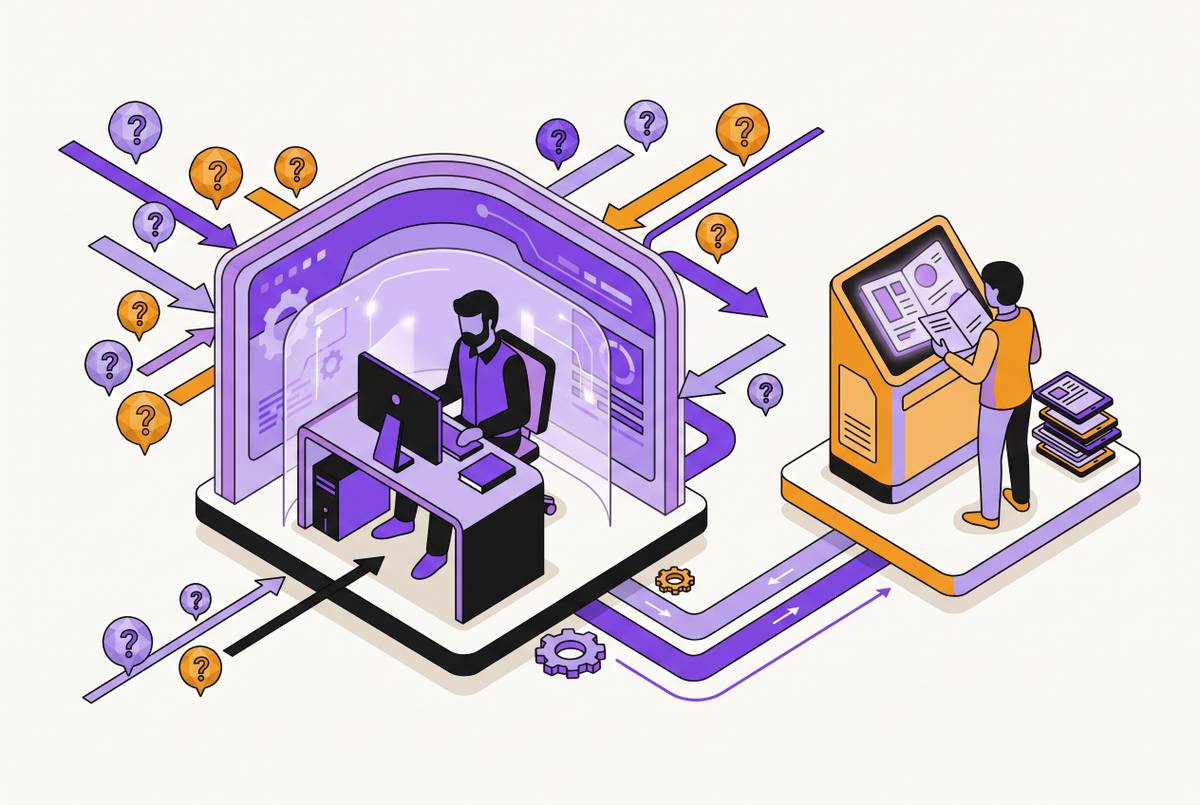
The single highest-leverage human investment in monorepo onboarding is a dedicated buddy assigned for the new hire's first weeks. But the value depends entirely on how the buddy's job is defined. A buddy who answers every question creates dependency. A buddy whose job is to ensure no question goes unanswered for more than a few hours creates momentum and routes the new hire to the right owner. There are seven questions behind the one the new hire asked, and no single person can answer all of them.
Embedding AI tools into the onboarding process reframes the buddy relationship productively. What remains for the buddy is the transfer of context that no tool can surface: the ownership topology, the political landmines, the unwritten rules. When a new hire asks a lookup question, the buddy should point to the tool. When a new hire asks a judgment question, the buddy should answer it directly.
The buddy relationship is where ownership topology gets transferred most naturally. It exists only in the lived experience of having navigated the organization. A buddy who is treated as a human FAQ never transfers this knowledge, because the new hire never asks the questions that would surface it.
For senior hires specifically, the buddy role shifts. The buddy's job orients toward that layer of context, not toward syntax or conventions. A senior engineer who spends their first week being shown how the linter works is a senior engineer whose ramp has already failed.
The buddy cost is real and bounded, a few hours per week for a defined window, but it must be counted explicitly. Contrast this with informal mentoring, which has no definition, no end state, and no accounting. Informal mentoring is what teams do when they want the benefits of the buddy system without committing to its cost, and it produces exactly the uneven, interrupt-driven knowledge transfer the buddy system exists to prevent.
Architecture Walkthroughs and ADRs as Reusable Context Artifacts
The highest-value thing a senior engineer can do for future hires is convert a live explanation into a recorded artifact. A recording that lives in a shared drive no one can find is not a reusable asset. It is a gesture.
Repeated live explanation is the hidden tax. The first walkthrough costs two hours. Every one after the recording costs nothing.
ADRs work when they name the files they govern. When neither exists, git archaeology and rationale mined from comments still produce a reasoned account. The account is weaker than a formal ADR, but it is far stronger than the silence a new hire currently faces.
The failure mode is documentation drift. Stale documentation actively destroys the value it was meant to create. After the second dead end, they go back to Slack, and the interrupt tax resumes.
The structural fix is to make ADR creation part of the change process, not a separate documentation effort. The decision is written at the time the decision is made, linked to the relevant files, and owned by the team that made it. This is the only arrangement that keeps reasoning and code in sync, because it ties the life of the record to the life of the change. A decision recorded three sprints after it was made is already archaeology.
The limit of these artifacts, even well-maintained ones, is that no artifact anticipates every question. Neither can answer the question the new hire has at three in the afternoon, staring at a file, about code that predates any documentation effort. That question arrives at lookup time, not orientation time, and it is the boundary where human knowledge transfer reaches its structural limit.
Teaching New Hires to Read Ownership Topology Before Touching Code
The navigation skill that separates a safe first pull request from a disruptive one is the ability to read ownership topology: who owns what, who needs to be consulted, and where the invisible boundaries are. Senior engineers teach this skill almost entirely through example, which is why it transfers so unevenly. It is craft knowledge, and craft knowledge is taught by showing.
CODEOWNERS files surface the formal ownership layer, but they are incomplete. A new hire learns whom to ask for review before they open the PR, and the answer should come from the repository rather than from a guess. Reading it well is a skill.
Senior engineers teaching this skill walk new hires through how to read git blame not just for authorship but for patterns. The patterns matter more than the individual attributions. They tell the new hire where changes will be welcome and where they will be scrutinized, where consultation is mandatory and where it is optional.
The sequence matters as much as the checks themselves. The objection is that this slows down the new hire's first contributions. The answer is that it prevents the first contribution from breaking something, which is the event that resets trust and adds weeks to the ramp.
Where Human Knowledge Transfer Reaches Its Structural Limits
Human context transfer breaks down at the lookup layer. Buddies transfer ownership topology. None of these can answer the specific, in-the-moment question about a file the new hire is actually editing, because no artifact anticipated that exact question. Lookup happens at the moment of editing and cannot wait for a scheduled call.
Most lookup questions go to Slack. A new hire cannot grep for the answer to why a file has an odd data shape. The answer lives in a design decision made three years ago, or in the commit message of a refactor, or in the head of an engineer who has since left.
The practical payoff of addressable context is the questions that stop reaching Slack. Lookup questions become a query rather than an interrupt. When the codebase can answer three-quarters of its own questions, the remaining quarter that reaches Slack is the quarter that genuinely requires human judgment. The senior engineers become the bottleneck, and the bottleneck compounds with every new hire.
What the lookup layer requires is pre-indexed, queryable structure, ownership, call graphs, and history. They cannot be present at every moment a new hire has a question. That is where the structural limits of human knowledge transfer meet the structural capabilities of code intelligence tooling.
What Code Intelligence Tooling Does That Senior Engineers Cannot
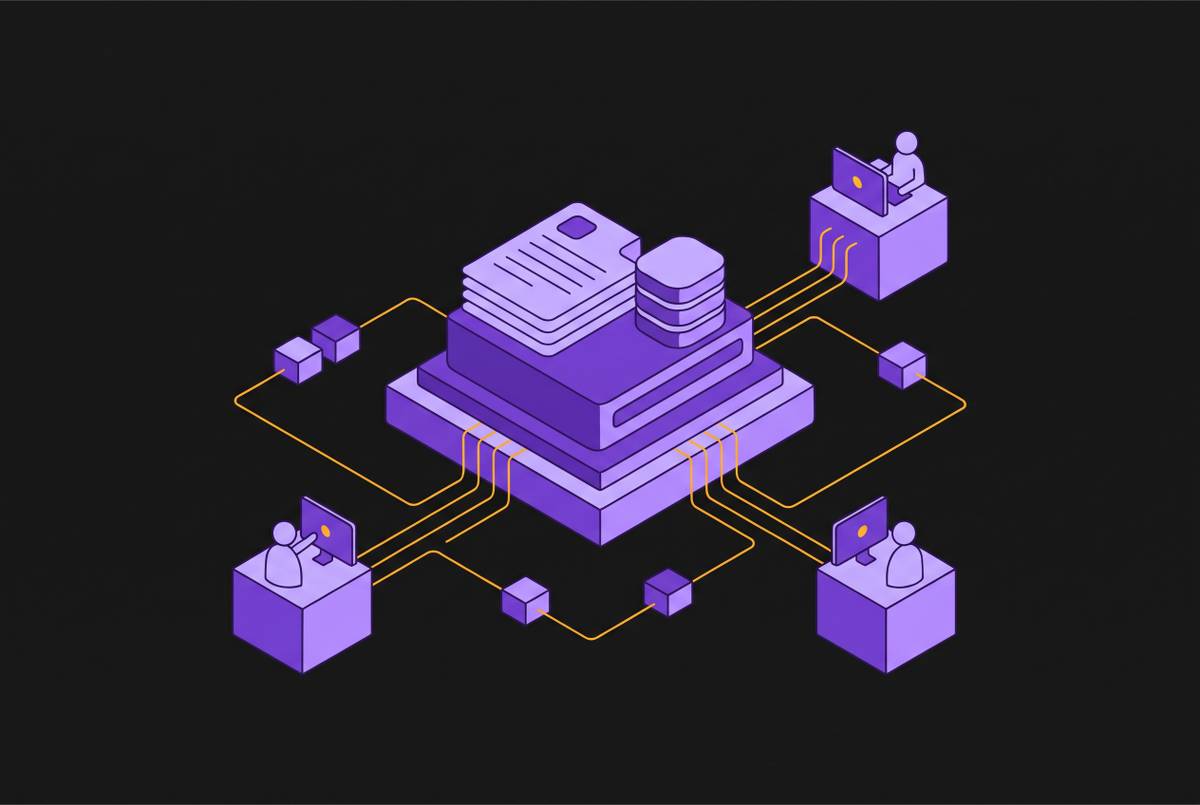
Code intelligence tooling addresses the lookup problem by pre-indexing structure, ownership, call graphs, and git history so that the answer to an in-the-moment question is available in seconds rather than requiring a human interrupt. A map generated from the code as it is today does not drift the way a README from three years ago does. The tooling reads the code, not the documentation about the code, which means it is always as current as the last commit.
For historical decision questions, the tooling answers in layers. A repo that never wrote an ADR still produces a reasoned account, because the tooling mines the commit history and comments that are always present. The answer is weaker than a formal record would be, but it is infinitely stronger than the silence a new hire currently faces.
For AI coding agents specifically, pre-indexed repository intelligence solves a different problem. Agents with only local context starve. Agents with pre-indexed context produce output that reflects the whole system, which is the entire point of working in a monorepo.
The privacy question is not optional for enterprises. Self-hosted deployment is the only architectural guarantee of data residency, as opposed to retention agreements that govern what a SaaS vendor does with code it has already received. For an enterprise whose code is a competitive asset, the distinction between the two is the entire procurement decision.
The context that lives in senior engineers' heads with no durable, queryable form is exactly where tooling like Sourcebot steps in. The mechanism is the point. Indexing the code as it exists today creates a queryable surface that no documentation process can match for currency.
Choosing a Code Intelligence Platform: Sourcebot, Repowise, and What Each Deployment Model Means for Enterprise Teams
For enterprise teams, the most consequential choice in code intelligence tooling is deployment model. A SaaS platform substitutes retention agreements for architectural data-residency guarantees. That single difference drives more of the procurement decision than any feature comparison.
Sourcebot is the self-hosted option, and it leads with the data-residency argument. It indexes code across every repository in the organization and provides natural-language search for engineers and new hires, reducing the interrupt load on senior engineers by making the codebase queryable without a human intermediary. It supports bring-your-own-model LLM configuration, so teams choose their provider and retain full control over where code is sent to inference. AI coding agents such as Cursor and Claude Code can be given full codebase context through Sourcebot's MCP layer, which addresses the context-starvation failure mode on large monorepos. The best fit is enterprise and mid-market teams with large, complex codebases, sensitive code that must not leave the environment, and mixed audiences of engineers and non-engineers who need to query the codebase.
Repowise takes a different approach. It is open-source and self-hostable with a hosted SaaS tier, purpose-built for codebase intelligence for AI agents and engineering teams. The tool surface includes get_overview, search_codebase, get_context, get_why, get_change_risk, and five other tools. A team that cannot will find Sourcebot's architectural guarantee disqualifying in the other direction.
Pairing a dedicated buddy with natural-language code search changes what the buddy relationship is for. The buddy's interrupt load drops. What remains is the transfer of tacit knowledge that tooling cannot surface on its own, and that transfer is the entire reason to have a buddy in the first place.
The Sequence That Actually Works: Orienting Before Searching, and Searching Before Changing
New engineers get up to speed on a large, unfamiliar codebase faster when their first weeks follow a fixed order. The fastest path from zero context to a safe first contribution in a monorepo runs in a predictable sequence: orient on the whole system before any single file, recover the decision behind code before changing it, and check blast radius and ownership before opening a PR. The sequence is the discipline.
Step one is to orient on system shape first. That map is coarse. It says where things live, not how they work, and that is exactly enough.
Step two is to find where the change belongs before reading the file. The new hire describes what they are trying to change, and the search returns candidate locations. From there, a context tool gives a triage card without the source: what the file does, its signatures, its owner, and its fix history, with callers available on request. That is enough to decide whether this is the right file before reading all of it.
Step three is to recover the decision before making a change. The question is never whether the code looks odd. It is whether there is a reason for the oddness, and whether that reason still holds.
Step four is to check blast radius and ownership before opening the PR. The calendar is a guide. The sequence is the discipline. The buddy is the backstop for judgment, not the answerer of lookups, and this is where that distinction pays off.
The compounding benefit is the point. Each iteration through the four steps encodes the system's shape more deeply, until the checks become automatic and the new hire is navigating independently. The Time to 10th PR metric is the right benchmark for measuring whether this sequence is working. One who reaches ten quickly but unsafely has not, and the distinction shows up in the code review history.