How a Code Context Layer Translates Repository Structure Into Something an AI Agent Can Actually Use
Machine-readable artifacts let agents navigate a codebase without reading thousands of files.
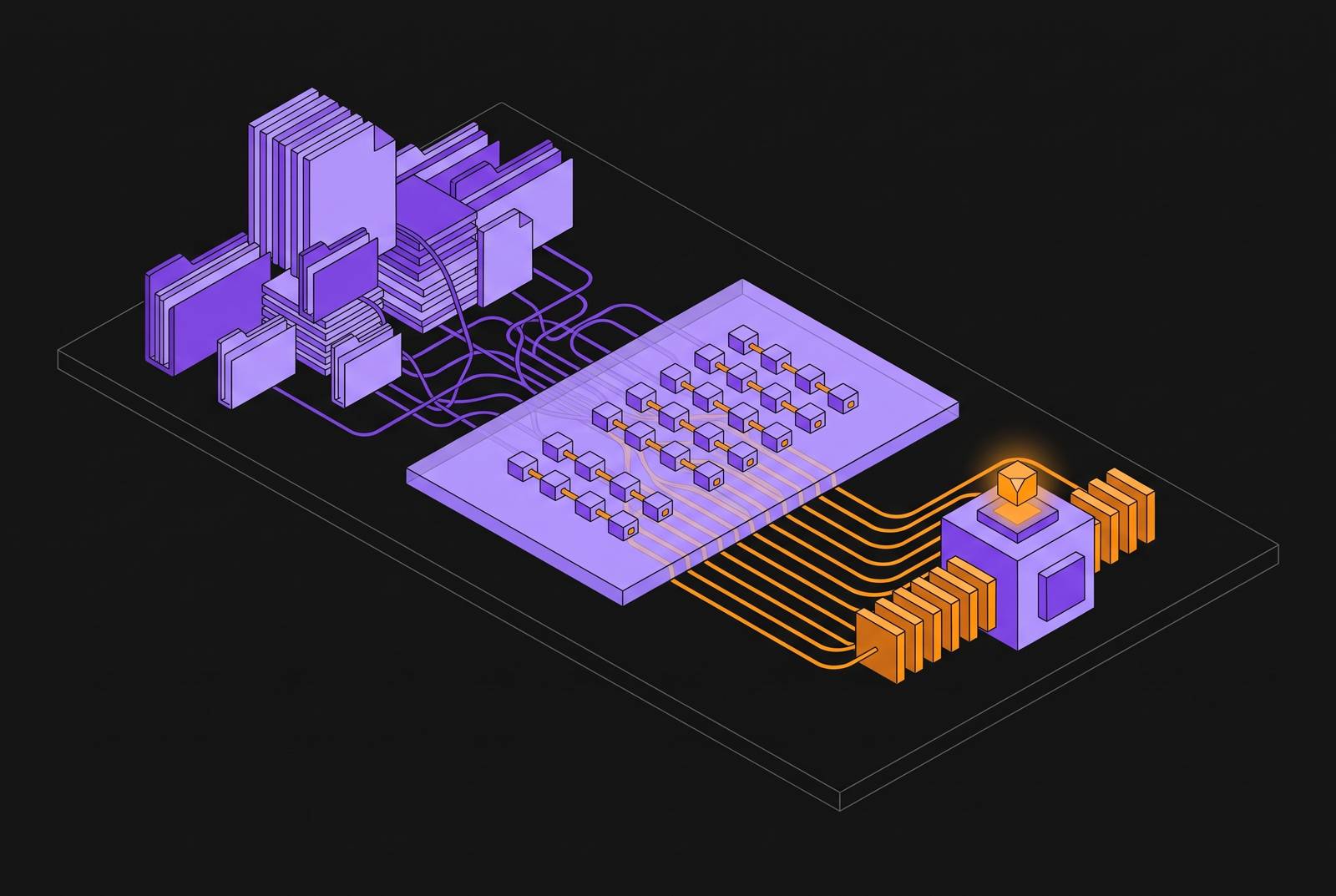
A code context layer for agents translates repository structure, dependencies, conventions, and business rules into structured, queryable artifacts an agent can plan against. It gives an agent relevant knowledge through short instructions, scoped guidance, and on-demand graph queries rather than loading an entire codebase into its context window. Its effectiveness depends on keeping those artifacts current, testing their correctness, and making dependencies visible across repository boundaries.
Why AI agents fail without a context layer, and what "context" actually means in code
One agent approves a supplier payment using stale vendor data, while a parallel agent blocks it using a different, outdated policy record. Both answers look right based on what each agent can see. Neither has the complete, approved context. The same failure occurs in code when an agent changes an API field without seeing its frontend consumers or changes a column without seeing the shared types that depend on it.
Codebases are organized for human cognition, with knowledge divided among directories, dependencies, conventions, and engineers. An agent can write code that works within the part it can see but breaks consumers outside it. In this setting, context means machine-readable artifacts between the repository and the agent.
Context engineering designs the information ecosystem around those artifacts, including instructions, tools, memory management, and observability. A prompt directs one interaction. A context layer supplies governed knowledge before that interaction begins, so the agent does not have to reconstruct the project’s rules and relationships from whichever files it happens to find.
The tiered structure of a code context layer — what it contains and how the tiers differ
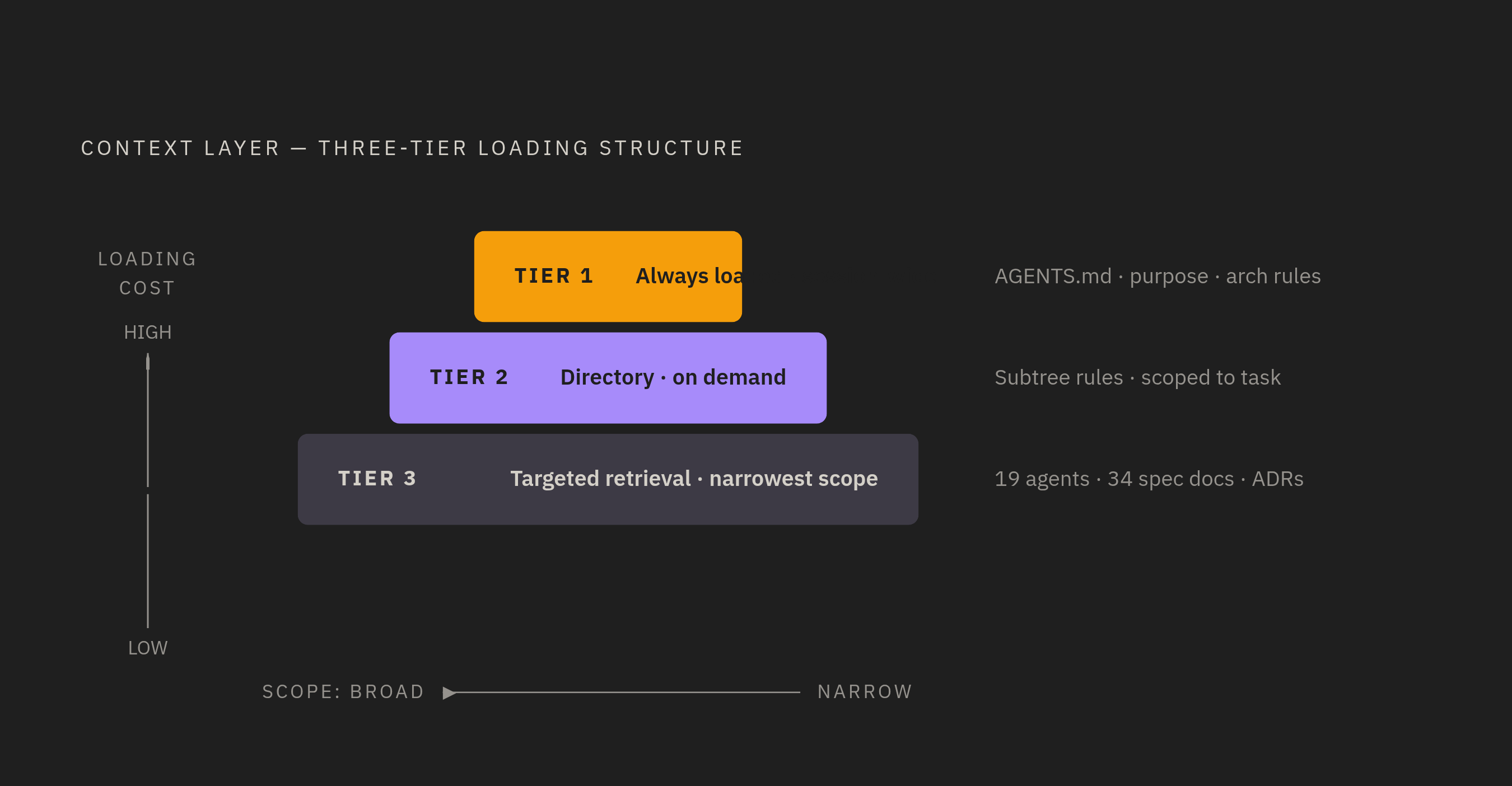
A working context layer separates knowledge into three tiers with different scopes and loading costs. The first is always-loaded, session-wide guidance in a root instruction file. Because that guidance consumes context regardless of the task, it should contain only broadly applicable information, including project purpose, repository organization, install and run commands, verification commands, architectural rules, protected files, and security boundaries.
AGENTS.md is the open standard that works across tools for this instruction layer, while CLAUDE.md is the native format for Claude Code. As of 2026, Claude Code reads AGENTS.md as a fallback when no CLAUDE.md exists, starting with v2.1.277. OpenAI Codex CLI, Cursor, Aider, Devin, GitHub Copilot, and Windsurf also read AGENTS.md natively. Gemini CLI defaults to GEMINI.md and requires a configuration change to read AGENTS.md, so broad portability does not eliminate tool-specific configuration.
The second tier contains directory-level instructions loaded only for work within the relevant subtree. A frontend task does not need to load API-layer rules. The third tier has specifications, architecture decision records, dependency graphs, and domain-expert configurations that agents can load as needed. Aristidis Vasilopoulos’s study of a 108,000-line C# distributed system described how it used a hot-memory constitution, 19 specialized domain-expert agents, and 34 cold-memory specification documents.
Atlan’s context repository guide describes “a GitHub repository for agent context” that bundles semantic models, skills, tools, policies, evaluation cases, and interaction traces by domain. Different agents receive overlapping knowledge. Outdated context can be more dangerous than missing context because it gives an agent confidence in assumptions the codebase no longer supports.
How do you give an AI coding agent codebase awareness without overloading its context window?
The first translation decision turns tacit conventions into explicit instructions. Stable repository-wide rules belong in AGENTS.md, temporary feature requirements belong in the task prompt, and long reusable procedures belong in separate skill files. This split keeps the requirements for one task from becoming rules for the whole project. It also separates guidance from enforcement. Permissions, hooks, and CI must enforce security guarantees because natural-language instructions are not a security boundary.
The second decision translates file trees and symbol relationships into a structural code index. A queryable graph of functions, classes, call chains, and module boundaries lets the agent find entry points, inspect callers and callees, and identify affected files before reading source. Without it, every session repeats the discovery loop of searching names, opening nearby files, and inferring ownership. Parallel agents repeat that work independently. The index replaces broad exploration with targeted navigation.
That navigation still needs a source of truth. The operating rule is to use the graph for orientation and source files, tests, and runtime behavior for correctness. Static indexes can become stale or miss routes generated through framework conventions, behavior hidden behind decorators, and metaprogramming. For high-stakes changes, direct search should look for errors in graph results as well as evidence that they are right.
The third decision turns the terms a business uses and the knowledge its people hold into structured definitions. A semantic model names the entities and metrics, and business definitions, trusted asset pointers, and policy rules set out what they are approved to mean and how they may be used. Evaluation cases test whether those artifacts lead to answers that follow the rules. Without this layer, the payment scenario can diverge further into an escalation based on an outdated contract note or an approval using the wrong exception logic.
The fourth decision exposes these artifacts through a common tool interface. MCP, the Model Context Protocol, lets multiple agent tools query one context surface instead of requiring a separate integration for each interface. Compatibility still requires attention to protocol versions. Claude Code requests the MCP 2026-07-28 revision by default, while Codex’s implementation of that revision is under active development and off by default as of October 2026.
The fifth decision extends structural indexing into a persistent knowledge graph of functions, classes, HTTP routes, call chains, and cross-service links. The agent can then retrieve relationships by type rather than read source files sequentially to infer them. This changes the planning budget. A dependency question that requires thousands of tokens of exploration leaves less room for reasoning than a graph lookup costing hundreds, especially when the answer spans repositories.
Where context layers become load-bearing infrastructure: cross-repo coordination at scale
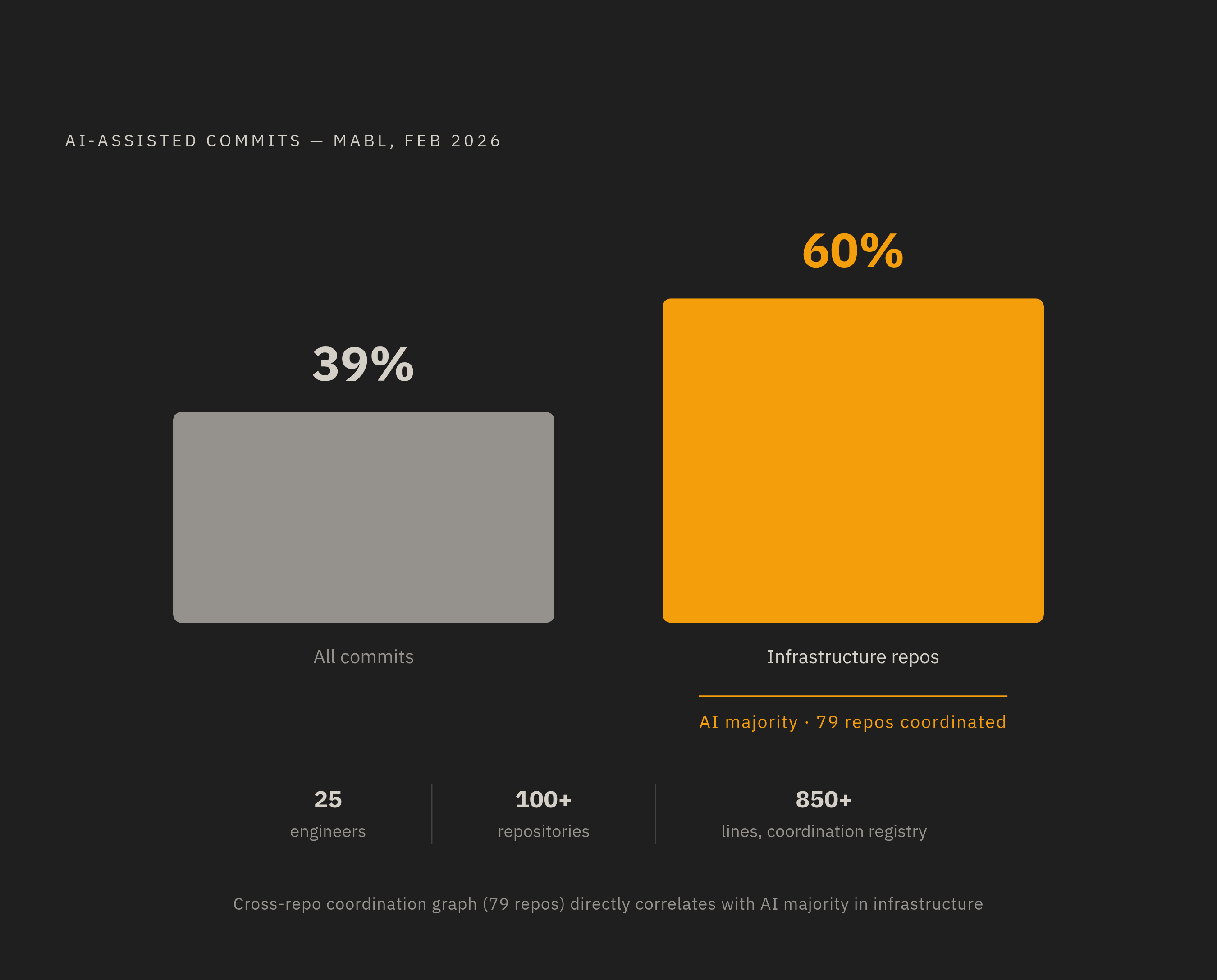
Mabl’s 25 engineers managed 100+ repositories and built a “Repo Coordination Graph” covering 79 of them in 850+ lines of structured registry. It records dependencies, Pub/Sub topic maps, who owns each database table, and the order in which releases must happen. Agents query it to identify affected repositories, determine merge order, and select reviewers from CODEOWNERS and dependency chains. By February 2026, 39% of Mabl’s commits were AI-assisted, rising to 60% in infrastructure repositories. Coordination was no longer a single-repository concern.
Meta’s multi-stage AI pipeline produced a cross-repo dependency index and data flow maps showing how changes propagate. It turned a dependency question from multi-file exploration into one graph lookup at a fraction of the token cost. The token saving allows dependency information to fit into an agent’s planning context without consuming the space needed to reason about the change.
Smaller operations can use a lighter coordination model. A solo founder managing 15+ repositories across Go, Rust, TypeScript, Python, and C++ used a manager agent to hold the plan while workers wrote to individual repositories in isolated git worktrees. That pattern works when the coordination plan is small enough to fit in one agent’s working memory. Mabl and Meta instead illustrate dependency structures that exist outside agents, refresh automatically, and outlast sessions. As the organization grows, the coordination model must become queryable data rather than remain an agent’s temporary understanding.
How a well-built context layer accelerates onboarding, and why agents alone do not
The same knowledge gap limits new engineers. An agent can help a new hire write a function faster without knowing where that function belongs, which conventions govern it, or which services it affects. The instruction files, dependency maps, and business definitions needed by the agent also provide the new hire with a route through an unfamiliar system.
Teams using shared Git-based context report shorter onboarding for engineers and contractors because project knowledge is written down and version-controlled. When that context is part of onboarding, a new hire can resolve questions without waiting for a senior engineer’s Slack reply. A first meaningful PR can arrive in days, advancing its arrival from the second or third week. The benefit extends beyond engineering. Product managers and support staff can query the same artifacts in natural language to understand a service, a field, or component ownership.
A wiki does not automatically provide this interface. Per-agent authentication, inconsistent wiki-to-Markdown exports, and version history trapped inside a user interface make its contents harder to retrieve and compare. Instructions also need peer review. Anthropic’s 2026 prediction that onboarding timelines could collapse from weeks to hours sets a forward-looking expectation. Reaching it depends on accessible project knowledge.
The verification problem that richer context creates, and how to contain it
More context does not guarantee correct or safe output. A context layer reduces planning errors caused by missing project knowledge, but it does not establish that an implementation behaves correctly. Sonar’s 2026 State of Code Developer Survey found that 96% of developers did not fully trust AI-generated code to be functionally correct.
Accurate context can prevent hallucinated patterns and misapplied conventions, while incorrect context can spread those errors across otherwise independent agents. A stale instruction file or dependency graph therefore creates a shared failure source. The remedy is to subject context to the engineering controls needed for other inputs that influence production changes.
Teams should version-control context files, peer-review changes, and update them as a standard part of codebase changes. Evaluation cases should then run before agents in production get the updated context. These tests can establish whether revised definitions and rules produce the expected governed answers. Output review and security enforcement remain necessary.
Data privacy and where the context layer's data physically lives
A context layer can reveal far more than individual source files because it maps relationships across the system. Its location is therefore a first-class design decision. Three questions define the privacy boundary, namely what code context leaves the machine, who can use it for training, and whether telemetry can be audited or disabled. A contractual promise not to inspect code differs from an architecture that prevents code from leaving the network.
“Self-hosted” does not settle that distinction by itself. Some deployments keep checkouts and builds on customer hardware while sending inference to a vendor’s cloud. Execution is local, but the inference boundary is not. Gartner predicts that by 2026, 50% of governments worldwide will enforce responsible AI through regulations, policies, and the need for data privacy. Deployment boundaries consequently belong in the architecture discussion.
A self-hosted code intelligence platform can build, store, and serve context inside the customer’s infrastructure. A single-container deployment is one way to do this, and local models run through Ollama, vLLM, or LM Studio can keep inference inside the network boundary too. MCP-based connectors can support external tools such as Jira, Linear, and Confluence without requiring repository content to be exported. The decisive criterion is the complete data path. Hosting the index internally is insufficient if a later stage sends sensitive context outside the permitted environment.
What it takes to build a context layer that holds up at enterprise scale
For an enterprise team, the engineering requirement is a connected system. It needs tiered guidance, an automatically refreshed structural index, cross-repository dependencies stored outside agent sessions, business definitions, evaluation cases, and a common delivery interface. Organization-wide indexing must extend beyond the repository open in an editor. Access controls must also follow the organization’s permission model, so the ability to find more does not give agents access to things they have no right to see.
Durability requires an explicit maintenance policy. Context changes should go through code review workflows, structural indexes and dependency graphs should refresh on their own, and context updates should pass evaluations before they are used in production. Files not reviewed within a defined period should be flagged as potentially outdated. Manual maintenance does not stay current at the cadence of a team managing 79 repositories. Freshness must be designed into the system.
Mabl’s registry and Meta’s parsing pipeline took dedicated engineering work, so teams should weigh whether building similar infrastructure is the right use of their platform engineering team’s time. Purpose-built infrastructure can provide organization-wide indexing and an MCP tool surface from a single Docker container inside the customer’s network. The buying criteria remain the same as the building criteria. The context layer must make the right relationships retrievable, preserve access and data boundaries, and demonstrate that its knowledge still matches the code.